Thursday, January 01, 2009

HAPPY NEW YEAR!!!!!!!!!!!


I want to wish everyone a
Happy New Year!!!!!!!!!!!!

Thanks to all of the readers of this blog for your support and contributions during 2008.........unfortunately I must put this blog on hiatus once again............


I have been unemployed for the last 2 months ( which is why you may have noticed an increase in postings).........However I have been offered and accepted a job in Eastern Washington and I don't know if I'll have internet access over there........I will get back to this blog whenever I can and continue to track what the "crazies" in D.C. are up to.........We have hope for change in the new year and it will truly begin on Jan.20th........the extent of change is still yet to be determined.......So I hope and pray for a better world in 2009.............


GOOD LUCK
to us all !!!!!!!!!!!............... PEACE............... Scott

January 1:


1959 : Batista forced out by Castro-led revolution

On this day in 1959, facing a popular revolution spearheaded by Fidel Castro's 26th of July Movement, Cuban dictator Fulgencio Batista flees the island nation. Amid celebration and chaos in the Cuban capitol of Havana, the U.S. debated how best to deal with the radical Castro and the ominous rumblings of anti-Americanism in Cuba.

The U.S. government had supported Batista, a former soldier and Cuban dictator from 1933 to 1944, who seized power for a second time in a 1952 coup. After Castro and a group of followers, including the South American revolutionary Che Guevara (1928-1967), landed in Cuba to unseat the dictator in December 1956, the U.S. continued to back Batista. Suspicious of what they believed to be Castro's leftist ideology and worried that his ultimate goals might include attacks on the U.S.'s significant investments and property in Cuba, American officials were nearly unanimous in opposing his revolutionary movement.

Cuban support for Castro's revolution, however, grew in the late 1950s, partially due to his charisma and nationalistic rhetoric, but also because of increasingly rampant corruption, greed, brutality and inefficiency within the Batista government. This reality forced the U.S. to slowly withdraw its support from Batista and begin a search in Cuba for an alternative to both the dictator and Castro; these efforts failed.

On January 1, 1959, Batista and a number of his supporters fled Cuba for the Dominican Republic. Tens of thousands of Cubans (and thousands of Cuban Americans in the U.S.) celebrated the end of the dictator's regime. Castro's supporters moved quickly to establish their power. Judge Manuel Urrutia was named as provisional president. Castro and his band of guerrilla fighters triumphantly entered Havana on January 7.

The U.S. attitude toward the new revolutionary government soon changed from cautiously suspicious to downright hostile. After Castro nationalized American-owned property, allied himself with the Communist Party and grew friendlier with the Soviet Union, America's Cold War enemy, the U.S severed diplomatic and economic ties with Cuba and enacted a trade and travel embargo that remains in effect today. In April 1961, the U.S. launched the Bay of Pigs invasion, an unsuccessful attempt to remove Castro from power. Subsequent covert operations to overthrow Castro, born August 13, 1926, failed and he went on to become one of the world's longest-ruling heads of state.

Fulgencio Batista died in Spain at age 72 on August 6, 1973.
In late July 2006, an unwell Fidel Castro temporarily ceded power to his younger brother Raul. Fidel Castro officially stepped down in February 2008.

~~~~~~~~~~~~~~~~~~~~~~~~~~~~~~~~~~~~~~~~~~~~~~~~~~~~~

General Interest
1959 : Batista forced out by Castro-led revolution
http://www.history.com/tdih.do?action=tdihVideoCategory&id=52297
45 BC: New Year's Day
http://www.history.com/tdih.do?action=tdihArticleCategory&id=6763
1803 : Haitian independence proclaimed
http://www.history.com/tdih.do?action=tdihArticleCategory&id=4632
1863 : Lincoln issues Emancipation Proclamation
http://www.history.com/tdih.do?action=tdihArticleCategory&id=4633
1876 : First modern Mummers' Parade
http://www.history.com/tdih.do?action=tdihArticleCategory&id=4634

Could the U.S. dollar be worth 40 percent less by next Chritmas?‏

Dick McManus

FORECAST FOR 2009
By
Jim Kunstler (author of the book the future after peak oil, The Long Emergency)

A summary of his commentary:

December 28, 2008: I worry that the avalanche of troubles already ongoing will overwhelm Mr. Obama and his people. ... President Obama's ( role will be) largely symbolic -- as a reassuring presence encouraging the distressed public to bravely bear their hardships, and to be kind and helpful among their neighbors.
This is an idle hope, and 2009 will be very sobering for those who imagine that hybrid cars, or electric cars, or natural gas cars, or any other kind of car technology will save the day. Even if President Obama mounts an "infrastructure stimulus" program, it will not keep up with all the necessary routine road repair that our highway system requires. The extreme financial hardship faced by localities and states insures that they will have to postpone a lot of expensive highway maintenance -- even if the federal government fixes a big bunch of bridges and tunnels -- and so we face the interesting prospect that our roadway systems will enter their own deadly zone of systemic failure even before the whole car issue is settled.
The car is going to fail in manifold ways whether we like it or not, and it will fail due to circumstances already underway. For one thing, it will cease to be democratic as the
remnants of the middle class find it impossible to get car loans, or pay for fuel, or insurance, and that will set in motion a very impressive politics-of-grievance setting apart those who are still able to enjoy motoring and those who have been foreclosed from it.
Contrary to what you might make of the the current situation in the oil markets, we are in for a heap of trouble with both the price and supply of petroleum (more on this below). And there is no chance in hell that any techno rescue remedy to keep all the cars running by
other means will materialize.
We could see the start of serious inflation sometime in 2009. To some extent, all currencies are now free-falling together, but the situation of the U.S. dollar is so grotesquely dire, An inflationary campaign to avoid compressive deflation can so easily lead to a fiasco of super or hyper inflation -- the kind that kills governments and turns societies into murderous monsters. I'll forecast the that the U.S. dollar is worth 40 percent of its current value by next Christmas.
By May of 2009, the stock markets will resume crashing with the ultimate destination of a Dow 4000 before the end of the year. Meanwhile, jobs will vanish by the millions and companies will go bankrupt by the thousands, especially in the so-called service sector, and in all the suppliers of such, along with the landlords in all the malls and strip malls. the consumer economy is dead, and that there is no more available credit
of the kind that Americans are in the habit of enjoying.
In 2009, we will discover that we are a much poorer nation than we thought because from now on credit will be extremely hard to get for anyone for anything. The businesses that survive will have to keep going on the basis of accounts receivable. This is the area where the crash of giants will be heard. ... (there will be a) comprehensive downscaling in all our activities, from farming to business to schooling to governance, will be the categorical imperative of the years ahead. The federal government will tend to flounder just as General Motors, Citicorp, Target Stores, and other gigantic enterprises will tend to flounder.
Counties, municipalities, and states will join in the bankruptcy fiesta. It would be reasonable to expect collapsing services as a result. This would be a situation fraught with danger -- of rising crime, of public health emergencies as water systems are not kept up and sewage treatment becomes unaffordable. I don't imagine the federal government stepping into every Podunk or Metropolis from sea to shining sea and propping up these services. People will have to cope with danger and deprivation.

A lot of families will lose everything. They will sift and disperse into the housing
owned by other family members -- parents, siblings -- and a strange new not-altogether comfortable kind of togetherness will become common. Over time, a lot of people will go looking for casual work "under-the-table"( and probably low-paying). To some degree, these workers will begin to look and act like a new servant class, and before too long they may be absorbed into the households of people who employ them. There will be plenty of room for them there.

2009 may be the point where we begin to understand what kinds of places will be more hospitable to human society further ahead. I maintain that our giant urban metroplexes have way overshot their sustainable scale and will contract severely. With all the economic hardship, we ought to expect a lot of demographic churning, people leaving hopeless places and moving on to something more promising. I believe we will see them move to smaller towns and smaller cities. The reorganization of the rural landscape into smaller-scaled farms has not begun to occur -- though 2009 might be very hard on
agribusiness, given the shortage of capital and if oil begins to march up in price by late winter. Eventually, the rural landscape will require the labor of many more people than is currently the case. Whatever else happens, 2009 will surely see a massive return to home
gardening as budgets become strained to the extreme.
Jim Hansen's Master Resource Report says that gasoline consumption dropped from 9.29 million barrels a day in 2007 to 8.99 million barrels a day for 2008. That's not much of a fall-off, especially compared to the price drop. So much capital is leaving the oil production-- system and so the hope of offsetting very-near-future depletions in old giant oil fields looks dimmer and dimmer.

Mexico's super-giant Cantarell oil field, the second-largest ever discovered after Saudi
Arabia's Ghawar field, has shown a 30 percent depletion rate in the past year alone.
Mexico is America's third largest source of imports My prediction for 2009 is that we will see two things occur, possibly at the same time: a resumption of rising prices, and spot shortages.
China's internal problems are still enormous and worsening. They're in trouble with water, food imports, mass unemployment, and energy. They have locked in some oil contracts
around the world, but they are still susceptible to vagaries in the oil markets and Black Swan events. As the U.S. consumer economy falls into a coma, and the shipping containers from China to WalMart get sparser, the Chinese government will face the wrath of millions of unemployed workers. I believe they will struggle through 2009, perhaps growing more surly as the U.S. dollar inflates and their holdings of Treasury bills begins to look more like a swindle.

Russia may be suffering economically for the moment due to the crash of oil prices, but they are energy resource-rich -- at least for the next couple of decades -- and if they don't like the current price, they can keep more of their oil in the ground until the price looks
more attractive.
Japan import 95 percent of the energy they use.
NOTE: Also see the current issue of Foreign Affairs magazine, "The Great Crash, 2008," subtitle, A geopolitical setback for the West, by Roger C. Altman.

The over-arching geopolitical theme of 2009 will be the end of robust globalism as we've known it for some time. Reduced trade, competition for energy resources, sore feelings over debts and currencies will drive the nations inward or, at least, direct their energies toward their own regions.
The big theme for 2009 economically will be contraction. This contraction will do its work in unpleasant ways, driving down standards of living, shearing away hopes and expectations for a particular life of comfort, and introducing disorder to so many of the systems we have depended on for so long. People will starve, lose their homes, lose incomes and status, and lose the security of living in peaceful societies. It
will become clear that the Long Emergency is underway.
911 Molten steel and fireproofing replaced on the floor hit by the airplanes
There appears to be a remarkable correlation between the floors that had been upgraded with new fireproofing in the WTC towers, in the years preceding 9/11/01, and the floors of impact, fire and failure.
The fireproofing upgrades would have allowed for the exposure of the floor assemblies and the columns for a significant period of time.
The two airplanes that struck the twin towers of the World Trade Center on 9/11 had directly impacted secure computer rooms in bothbuildings:
· the first on the 95th floor of the North Tower;

· the second on the 81st floor of the South Tower.

Fuji Bank had reinforced the 81st floor, he said, so the floor could
support more weight. The entire floor was then filled with server-
size Uninterrupted Power Supply (UPS) batteries.

These units were bolted to a raised floor about 3 feet above the
reinforced 81st floor. "The whole floor was batteries," he
said, "huge battery-looking things." They were "all black"
and "solid, very heavy" things that had been brought in during the
night. They had been put in place during the summer prior to 9/11,
he said.
On the 95th floor of WTC 1, Marsh & McLennan had a "large walled
data center," a secure computer room along the north and east sides
of the tower. And that's exactly where the plane hit ­ the north wall
of the 95th floor.
Fuji Bank was the tenant of floors 79-82, yet for some reason the
NIST researchers were unable or unwilling to provide any description
of the contents of these crucial floors ­ four years after 9/11.

http://www.rense.com/general75/thrm.htm
NIST is trying to say that the molten steel was created after the building collapse. How do they know that? If so, why isn’t it mentioned in a 10, 000 page report to show this?
Tons of molten metal found by FDNY and numerous other experts under all 3 high-rises “like lava from a volcano.” Streams of “molten metal which was still red-hot weeks after the event.” “Firemen sprayed water to cool the debris but the heat remained intense enough at the surface to melt their boots.” The fire was not completely extinguished until over 3 months after 9/11.
Chemical signature of Thermate (high tech incendiary) found in slag, solidified molten metal, and dust samples by Physics Professor Steven Jones, Ph.D.

Examination of the forensic metallurgy of WTC steel “reveal a phenomenon never before observed in building fires: eutectic reactions, which caused ‘intergranular melting capable of turning a solid steel girder into Swiss cheese.’”
The simple facts of temperatures:
  • 1535ºC (2795ºF) - melting point of iron
  • ~1510ºC (2750ºF) - melting point of typical structural steel
  • ~825ºC (1517ºF) - maximum temperature of hydrocarbon fires burning in the atmosphere without pressurization or pre-heating (premixed fuel and air - blue flame)
Diffuse flames burn far cooler.
Oxygen-starved diffuse flames are cooler yet.
The fires in the towers were diffuse -- well below 800ºC.
Their dark smoke showed they were oxygen-starved -- particularly in the South Tower.

November 22, 2004
SOUTH BEND -- The laboratory director from a South Bend firm has been fired for attempting to cast doubt on the federal investigation into what caused the World Trade Center's twin towers to collapse on Sept. 11, 2001.
Kevin R. Ryan was terminated Tuesday from his job at Environmental Health Laboratories Inc., a subsidiary of Underwriters Laboratories Inc., the consumer-product safety testing giant.
On Nov. 11, Ryan wrote a letter to the National Institute of Standards and Technology -- the agency probing the collapse -- challenging the common theory that burning jet fuel weakened the steel supports holding up the 110-story skyscrapers.
Underwriters Laboratories Inc., according to Ryan, "was the company that certified the steel components used in the construction of the WTC buildings."
Ryan wrote that last year, while "requesting information," UL's chief executive officer and fire protection business manager disagreed about key issues surrounding the collapse, "except for one thing -- that the samples we certified met all requirements."
UL vehemently denied last week that it ever certified the materials.
Ryan wrote that the institute's preliminary reports suggest the WTC's supports were probably exposed to fires no hotter than 500 degrees -- only half the 1,100-degree temperature needed to forge steel, Ryan said. That's also much cooler, he wrote, than the 3,000 degrees needed to melt bare steel with no fire-proofing.
"This story just does not add up," Ryan wrote in his e-mail to Frank Gayle, deputy chief of the institute's metallurgy division, who is playing a prominent role in the agency investigation. "If steel from those buildings did soften or melt, I'm sure we can all agree that this was certainly not due to jet fuel fires of any kind, let alone the briefly burning fires in those towers."

In an effort to better understand the conditions that led to complete collapses of the World Trade Center Towers and WTC 7, we apply scanning-electron-microscope (SEM) and energy dispersive x-ray spectroscopy (XEDS) methods to analyze the dust generated, with an emphasis on observed micro-spheres in the WTC dust.

The formation of molten spheres with high iron contents along with other species in the

WTC dust required extremely high temperatures. Our results are compared with those of other laboratories. The temperatures required for the molten sphere-formation and evaporation of materials as observed in the WTC dust are significantly higher than temperatures associated with the burning of jet fuel and office materials in the WTC buildings.

The temperatures required for the observed spherule-formation and evaporation of materials observed in the WTC dust (table 1) are significantly higher than temperatures reachable by the burning of jet fuel and office materials in the WTC buildings (table 2). The temperatures required to melt iron (1,538 °C) and molybdenum (2,623 °C), and to vaporize lead (1,740 °C) and aluminosilicates (~2,760°C), are completely out of reach of the fires in the WTC buildings (maximum 1,100 °C). We wish to call attention to this discrepancy: the official

view implicating fires as the main cause for the ultimate collapses of the WTC Towers and WTC 7 (FEMA [13], NIST [15] ) is inadequate to explain this temperature gap and is therefore incomplete at best.

The formation of numerous metal-rich spherules is also remarkable, for it implies formation of high-temperature droplets of the molten metals, dispersed in the air where they cool to form spherules. We observe spherules with high iron and aluminum contents, a chemical signature which is not consistent with formation from melted steel.

The data provide strong evidence that chemical reactions which were both violent and highly-exothermic contributed to the destruction of the WTC buildings. NIST neglected the high-temperature and fragmentation evidence presented here: it appears nowhere in their final report [15]. Proposed new building codes based on the WTC disaster must address all available evidence for what caused the complete and rapid destruction of these skyscrapers. Understanding the mechanisms that led to the destruction of the World Trade Center will enable scientists and engineers to provide a safer environment for people using similar buildings and benefit firefighters who risk their lives trying to save others. Thus, a thorough investigation which considers these data, showing extremely high temperatures and severe fragmentation in the formation of small metal-rich spheres

during the WTC Towers destruction, is highly motivated. In particular, the repeatedly-delayed report on the destruction of WTC 7 on 9/11/2001 [21] should address these striking facts.

The extensive evidence that explosives were used at the WTC includes witness testimony (MacQueen 2006), overwhelming physical evidence (Griffin 2005, Hoffman et al 2005, Jones and Legge et al 2008) and simple common sense (Legge 2007). There is also substantial evidence that aluminothermic (thermite) materials were present at the WTC

(Jones 2007), and the presence of such materials can explain the existence of intense fire where it would not otherwise have existed. Additionally, despite agreement from all parties that the assumed availability of fuel allowed for the fires in any given location of each of the WTC buildings to last only twenty minutes (NIST 2007), the fires lasted much longer and produced extreme temperatures (Jones and Farrer et al 2008).

It turns out that explosive, sol-gel nano-thermites were developed by US government scientists, at Lawrence Livermore National Laboratories (LLNL) (Tillitson et al 1998, Gash et al 2000, Gash et al 2002). These LLNL scientists reported that --

"The sol-gel process is very amenable to dip-, spin-, and spray-coating technologies to coat surfaces. We have utilized this property to dip-coat various substrates to make sol-gel Fe,O,/ Al / Viton coatings. The energetic coating dries to give a nice adherent film. Preliminary experiments indicate that films of the hybrid material are self-propagating when ignited by thermal stimulus"

(Gash et al 2002).

The amazing correlation between floors of impact and floors of apparent failure suggests hat spray-on nano-thermite materials may have been applied to the steel components of the WTC buildings, underneath the upgraded fireproofing (Ryan 2008). This could have been done in such a way that very few people knew what was happening. The Port Authority’s engineering consultant Buro Happold, helping with evaluation of the

fireproofing upgrades, suggested the use of "alternative materials" (NIST 2005). Such alternative materials could have been spray-on nano-thermites substituted for intumescent paint or Interchar-like fireproofing primers (NASA 2006). It seems quite possible that this kind of substitution could have been made with few people noticing.

http://journalof911studies.com/volume/2008/Ryan_NIST_and_Nano-1.pdf

"Conspiracy" just means, more than one person being involved in something.
Genuine Conspiratorial Politics, what is that?
News and View you don't have to Lose, news emails, I summarized news items. If you really are interested in the subject, I recommend you go to the link or web address (orgininal source). http://groups.yahoo.com/group/NewsViewsnolose
In accordance with Title 17 U.S.C. Section 107, this material is distributed without profit for research and educational purposes. MY NEWSLETTER has no affiliation whatsoever with the originator of this article nor is MY NEWSLETTER endorsed or sponsored by the originator.
.
My ON-LINE book SOME UNKNOWN HISTORY OF THE U.S. http://groups.yahoo.com/group/SomeUnknownUSHistory/

Major Protest Against Gaza Assault in Washington, D.C. - Friday, Jan. 2 at 3:30 pm‏

ANSWER logo2


Please post this event on your Facebook and MySpace pages,
and forward it widely to your friends and family.


Major Protest Against Gaza Assault
Rally & March in Washington, D.C.

Friday, January 2 at 3:30 pm

Rally at the Israeli Embassy -
3514 International Dr, NW
(Van Ness metro on the Red line; near Connecticut & Van Ness)

Followed by march ending at the Egyptian Embassy
3521 International Ct, NW

gaza palestine white house
Yesterday, over 5,000 protesters in Washington, D.C.
marched from the State Department to the White House.

Yesterday, tens of thousands of people took to the streets in scores of cities across the country and around the world demanding an immediate end to the bombing of Gaza. In Washington D.C., 5,000 people gathered at the State Department and marched to the White House. Those taking to the streets included many children, teenagers and young adults. As the nighttime march entered the White House grounds, it took over and filled all of Pennsylvania Avenue with young people raising Palestinian flags at the White House fence. For a report on other demonstrations that happened all across the country, please visit the ANSWER Coalition website (see below).

The massacre of the Palestinian people continues. Nearly 400 Palestinians have been murdered. Israel has rejected any ceasefire, and the Egyptian government continues to block Palestinians who are trying to cross the border to escape the massive bombing campaign.

The ANSWER Coalition, Muslim American Society Freedom and the National Council of Arab Americans are calling for all progressive people to come out for a large-scale demonstration at the Israeli Embassy on Friday, January 2 at 3:30 pm. We will then march to the Egyptian Embassy.

Please make an urgently needed donation today.
Please make an urgently needed donation. We need your support to continue this work. Click here to donate online, where you can also find information on how to contribute by check.

Become a volunteer.
Our work is carried out entirely by volunteers. If you would like to become a volunteer, email info@answercoalition.org.

Read a report on demonstrations that were held all across the country.
To read a full report on the many demonstrations that were held in scores of cities across the country yesterday, Dec. 30, visit www.answercoalition.org.


A.N.S.W.E.R. Coalition
http://www.answercoalition.org/
info@internationalanswer.org
National Office in Washington DC: 202-544-3389
New York City: 212-694-8720
Los Angeles: 323-464-1636
San Francisco: 415-821-6545
Chicago: 773-463-0311
Seattle: 206-568-1661

Resist Imperialism / Che t-shirt
"Resist Imperialism"
t-shirts


End occupation tshirt
"End Occupation" t-shirt


resist imperialism sweatshirt
"Resist Imperialism"
Che hoodie

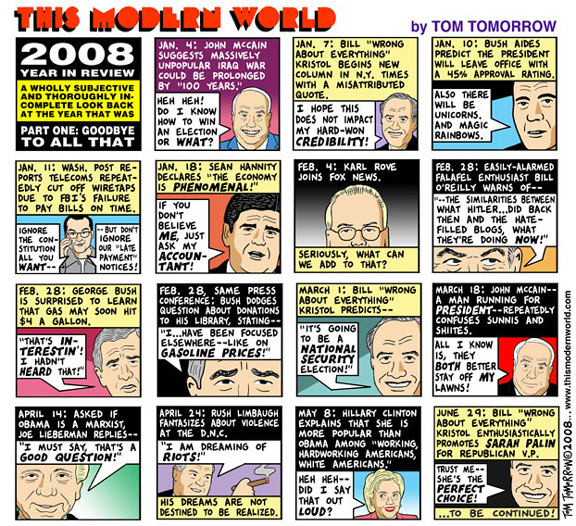
2008 Year in Review, Part One

Tom Tomorrow

Tom Tomorrow

Posted December 31, 2008 | 09:36 AM (EST)

2008 Year in Review, Part One

RSS stumble digg reddit del.ico.us news trust mixx.com Share this on Facebook

Show your support.
Buzz this article up.
Buzz up!

2008-12-31-YIR1huffpo1.jpg

More on Huffington Post...


Amb. Marc Ginsberg: Time for Hamas' Leaders to Go


2008-12-31-capt.4e2690cb335a402f980943285913a422.mideast_israel_palestinians_jrl153.jpg

AP/Khalil Hamra


Amb. Marc Ginsberg: Time for Hamas' Leaders to Go

Amb. Marc Ginsberg:
In order order to understand what this struggle is all about, one must understand Hamas' goals, largely derived from its ideological paternity to the Egyptian Muslim Brothehood. As a Sunni extremist offshoot of the Brotherhood, Hamas' raison d'etre is Israel's destruction -- nothing less will do. Despite my instinctive belief that one should try to negotiate a way out of this dilemma no matter the odds, I have concluded that the only way out of this mess is to separate Hamas' entire military and political leadership from the oppressed citizenry of Gaza (and yes, it is absolutely a mischaracterization of fact to assert that Hamas is the legitimate ruler of Gaza). Easier said than done you say. But as long as Hamas rules Gaza, no amount of cajoling is going to end the vicious cycle of terror that Hamas is inflicting first and foremost on its own beaten-down Palestinian victims as well as on Israel.what is Click here to read more.

Mid-Tunnel Glimmerings

»

by: Jean-Jacques Roth, Le Temps

photo
Jean-Jacques Roth sees two glimmers of light in our current situation: the possibility of concerted global action on the economy and the overthrow of greed as an ultimate value. (Photo: Simon / Santacruzin)

What a year! Wherever one turns: vertigo. Financial massacre, destruction of value unprecedented in human history, the unanticipated become an everyday occurrence, the most learned predictions trampled by phenomena deemed unthinkable just twelve months ago ...

If the essential purpose of crises is to incite us to think from scratch, this one should, by virtue of its scale, soon deliver a totally new world.

But for the moment, it's the absence of visibility that strikes the mind. A brutal, but short, fever, or durable chaos, soon to be matched by more serious disorders? We are en route to the unknown. No alternative is ready to replace the foundations of capitalism. No theory has appeared to clothe the disillusions provoked by the all-powerful market's turmoil with Utopias.

That's not bad news. In the past, too many dramas, too many wars accompanied economic spasms and the revanchist egotism of their nationalist managements or the adventurism of their revolutionary consequences.

The most precious gain of our era is therefore not only the progress in economic science since the 1929 crisis. It is in the awareness of a global world and in the presence of the supranational constructions that awareness begot. Whether the European Union or the World Trade Organization, these institutions have in common the action of checking the return of everyman for himself - the outcome of which is stubbornly tragic. Let us imagine for a moment what the present crisis would be like were the Euro and tariff regulations not there to prevent the competitive devaluations and customs protections that the past gratified us with!

But today we have a higher threshold to cross. The need for global governance to remediate the effects of global warming is already apparent. Today, it's the economy that must be reformed. The emergency is so striking that it is shaking up the inertia of the balance of power frozen in place by the victors of the Second World War. Through this unsuspected constraint, the rebalancing of the multipolar world could finally receive a decisive push on the accelerator.

That would be the first revolution of the twenty-first century, but it is not in itself a guarantee of effectiveness. At the WTO, we see the exhausting work a compromise between a multitude of more equal partners requires.

Will the regulation of the financial planet encounter the same roadblocks? That must be feared, should the return of politics limit itself to the invocation of having other people pay: the neighbors, future generations, but certainly not the yield on my government pension! The real requirement of the political is also to promote acceptance of the individual discipline and sacrifices that collective transformations demand.

It is obviously more convenient to wait for the bearer of hope - Barack Obama, of course. Will he be able to transform hope into acts and to become the president of a more reasonable world? His faultless career so far allows us to continue to believe it.

There's another reason to be gladdened in the short term. For this debacle will have at least defeated one fraud: that of a cupidity that had become insane, erecting its obscene fatuousness as a universal totem. We'll never be altogether done with it, of course, but will do at least two retakes before making it a cardinal value. In the tunnel we have entered, that's a glimmer at least as strong as the promises of concerted action on our common destiny.

So let us bet on the light: Happy New Year!

--------

Translation: Truthout French language editor Leslie Thatcher.

»

Drug Companies and Doctors: A Story of Corruption

»

by: Marcia Angell, The New York Review of Books

photo
The suppression of unfavorable pharmaceutical research in medical journals is the subject of Alison Bass's book, "Side Effects: A Prosecutor, a Whistleblower, and a Bestselling Antidepressant on Trial." (Photo: Pat Greenhouse / The Boston Globe)

Side Effects: A Prosecutor, a Whistleblower, and a Bestselling Antidepressant on Trial
by Alison Bass
Algonquin Books of Chapel Hill, 260 pp.

Our Daily Meds: How the Pharmaceutical Companies Transformed Themselves into Slick Marketing Machines and Hooked the Nation on Prescription Drugs
by Melody Petersen
Sarah Crichton/Farrar, Straus and Giroux, 432 pp.

Shyness: How Normal Behavior Became a Sickness
by Christopher Lane
Yale University Press, 263 pp.

Recently Senator Charles Grassley, ranking Republican on the Senate Finance Committee, has been looking into financial ties between the pharmaceutical industry and the academic physicians who largely determine the market value of prescription drugs. He hasn't had to look very hard.

Take the case of Dr. Joseph L. Biederman, professor of psychiatry at Harvard Medical School and chief of pediatric psychopharmacology at Harvard's Massachusetts General Hospital. Thanks largely to him, children as young as two years old are now being diagnosed with bipolar disorder and treated with a cocktail of powerful drugs, many of which were not approved by the Food and Drug Administration (FDA) for that purpose and none of which were approved for children below ten years of age.

Legally, physicians may use drugs that have already been approved for a particular purpose for any other purpose they choose, but such use should be based on good published scientific evidence. That seems not to be the case here. Biederman's own studies of the drugs he advocates to treat childhood bipolar disorder were, as The New York Times summarized the opinions of its expert sources, "so small and loosely designed that they were largely inconclusive."(1)

In June, Senator Grassley revealed that drug companies, including those that make drugs he advocates for childhood bipolar disorder, had paid Biederman $1.6 million in consulting and speaking fees between 2000 and 2007. Two of his colleagues received similar amounts. After the revelation, the president of the Massachusetts General Hospital and the chairman of its physician organization sent a letter to the hospital's physicians expressing not shock over the enormity of the conflicts of interest, but sympathy for the beneficiaries: "We know this is an incredibly painful time for these doctors and their families, and our hearts go out to them."

Or consider Dr. Alan F. Schatzberg, chair of Stanford's psychiatry department and president-elect of the American Psychiatric Association. Senator Grassley found that Schatzberg controlled more than $6 million worth of stock in Corcept Therapeutics, a company he cofounded that is testing mifepristone - the abortion drug otherwise known as RU-486 - as a treatment for psychotic depression. At the same time, Schatzberg was the principal investigator on a National Institute of Mental Health grant that included research on mifepristone for this use and he was coauthor of three papers on the subject. In a statement released in late June, Stanford professed to see nothing amiss in this arrangement, although a month later, the university's counsel announced that it was temporarily replacing Schatzberg as principal investigator "to eliminate any misunderstanding."

Perhaps the most egregious case exposed so far by Senator Grassley is that of Dr. Charles B. Nemeroff, chair of Emory University's department of psychiatry and, along with Schatzberg, coeditor of the influential Textbook of Psychopharmacology.(2) Nemeroff was the principal investigator on a five-year $3.95 million National Institute of Mental Health grant - of which $1.35 million went to Emory for overhead - to study several drugs made by GlaxoSmithKline. To comply with university and government regulations, he was required to disclose to Emory income from GlaxoSmithKline, and Emory was required to report amounts over $10,000 per year to the National Institutes of Health, along with assurances that the conflict of interest would be managed or eliminated.

But according to Senator Grassley, who compared Emory's records with those from the company, Nemeroff failed to disclose approximately $500,000 he received from GlaxoSmithKline for giving dozens of talks promoting the company's drugs. In June 2004, a year into the grant, Emory conducted its own investigation of Nemeroff's activities, and found multiple violations of its policies. Nemeroff responded by assuring Emory in a memorandum, "In view of the NIMH/Emory/GSK grant, I shall limit my consulting to GSK to under $10,000/year and I have informed GSK of this policy." Yet that same year, he received $171,031 from the company, while he reported to Emory just $9,999 - a dollar shy of the $10,000 threshold for reporting to the National Institutes of Health.

Emory benefited from Nemeroff's grants and other activities, and that raises the question of whether its lax oversight was influenced by its own conflicts of interest. As reported by Gardiner Harris in TheNew York Times,(3) Nemeroff himself had pointed out his value to Emory in a 2000 letter to the dean of the medical school, in which he justified his membership on a dozen corporate advisory boards by saying:

Surely you remember that Smith-Kline Beecham Pharmaceuticals donated an endowed chair to the department and there is some reasonable likelihood that Janssen Pharmaceuticals will do so as well. In addition, Wyeth-Ayerst Pharmaceuticals has funded a Research Career Development Award program in the department, and I have asked both AstraZeneca Pharmaceuticals and Bristol-Meyers [sic] Squibb to do the same. Part of the rationale for their funding our faculty in such a manner would be my service on these boards.

Because these psychiatrists were singled out by Senator Grassley, they received a great deal of attention in the press, but similar conflicts of interest pervade medicine. (The senator is now turning his attention to cardiologists.) Indeed, most doctors take money or gifts from drug companies in one way or another. Many are paid consultants, speakers at company-sponsored meetings, ghost-authors of papers written by drug companies or their agents,(4) and ostensible "researchers" whose contribution often consists merely of putting their patients on a drug and transmitting some token information to the company. Still more doctors are recipients of free meals and other out-and-out gifts. In addition, drug companies subsidize most meetings of professional organizations and most of the continuing medical education needed by doctors to maintain their state licenses.

No one knows the total amount provided by drug companies to physicians, but I estimate from the annual reports of the top nine US drug companies that it comes to tens of billions of dollars a year. By such means, the pharmaceutical industry has gained enormous control over how doctors evaluate and use its own products. Its extensive ties to physicians, particularly senior faculty at prestigious medical schools, affect the results of research, the way medicine is practiced, and even the definition of what constitutes a disease.

Consider the clinical trials by which drugs are tested in human subjects.(5) Before a new drug can enter the market, its manufacturer must sponsor clinical trials to show the Food and Drug Administration that the drug is safe and effective, usually as compared with a placebo or dummy pill. The results of all the trials (there may be many) are submitted to the FDA, and if one or two trials are positive - that is, they show effectiveness without serious risk - the drug is usually approved, even if all the other trials are negative. Drugs are approved only for a specified use - for example, to treat lung cancer - and it is illegal for companies to promote them for any other use.

But physicians may prescribe approved drugs "off label" - i.e., without regard to the specified use - and perhaps as many as half of all prescriptions are written for off-label purposes. After drugs are on the market, companies continue to sponsor clinical trials, sometimes to get FDA approval for additional uses, sometimes to demonstrate an advantage over competitors, and often just as an excuse to get physicians to prescribe such drugs for patients. (Such trials are aptly called "seeding" studies.)

Since drug companies don't have direct access to human subjects, they need to outsource their clinical trials to medical schools, where researchers use patients from teaching hospitals and clinics, or to private research companies (CROs), which organize office-based physicians to enroll their patients. Although CROs are usually faster, sponsors often prefer using medical schools, in part because the research is taken more seriously, but mainly because it gives them access to highly influential faculty physicians - referred to by the industry as "thought-leaders" or "key opinion leaders" (KOLs). These are the people who write textbooks and medical journal papers, issue practice guidelines (treatment recommendations), sit on FDA and other governmental advisory panels, head professional societies, and speak at the innumerable meetings and dinners that take place every year to teach clinicians about prescription drugs. Having KOLs like Dr. Biederman on the payroll is worth every penny spent.

A few decades ago, medical schools did not have extensive financial dealings with industry, and faculty investigators who carried out industry-sponsored research generally did not have other ties to their sponsors. But schools now have their own manifold deals with industry and are hardly in a moral position to object to their faculty behaving in the same way. A recent survey found that about two thirds of academic medical centers hold equity interest in companies that sponsor research within the same institution.(6) A study of medical school department chairs found that two thirds received departmental income from drug companies and three fifths received personal income.(7) In the 1980s medical schools began to issue guidelines governing faculty conflicts of interest but they are highly variable, generally quite permissive, and loosely enforced.

Because drug companies insist as a condition of providing funding that they be intimately involved in all aspects of the research they sponsor, they can easily introduce bias in order to make their drugs look better and safer than they are. Before the 1980s, they generally gave faculty investigators total responsibility for the conduct of the work, but now company employees or their agents often design the studies, perform the analysis, write the papers, and decide whether and in what form to publish the results. Sometimes the medical faculty who serve as investigators are little more than hired hands, supplying patients and collecting data according to instructions from the company.

In view of this control and the conflicts of interest that permeate the enterprise, it is not surprising that industry-sponsored trials published in medical journals consistently favor sponsors' drugs - largely because negative results are not published, positive results are repeatedly published in slightly different forms, and a positive spin is put on even negative results. A review of seventy-four clinical trials of antidepressants, for example, found that thirty-seven of thirty-eight positive studies were published.(8) But of the thirty-six negative studies, thirty-three were either not published or published in a form that conveyed a positive outcome. It is not unusual for a published paper to shift the focus from the drug's intended effect to a secondary effect that seems more favorable.

The suppression of unfavorable research is the subject of Alison Bass's engrossing book, Side Effects: A Prosecutor, a Whistleblower, and a Bestselling Antidepressant on Trial. This is the story of how the British drug giant GlaxoSmithKline buried evidence that its top-selling antidepressant, Paxil, was ineffective and possibly harmful to children and adolescents. Bass, formerly a reporter for the Boston Globe, describes the involvement of three people - a skeptical academic psychiatrist, a morally outraged assistant administrator in Brown University's department of psychiatry (whose chairman received in 1998 over $500,000 in consulting fees from drug companies, including GlaxoSmithKline), and an indefatigable New York assistant attorney general. They took on GlaxoSmithKline and part of the psychiatry establishment and eventually prevailed against the odds.

The book follows the individual struggles of these three people over many years, culminating with GlaxoSmithKline finally agreeing in 2004 to settle charges of consumer fraud for $2.5 million (a tiny fraction of the more than $2.7 billion in yearly Paxil sales about that time). It also promised to release summaries of all clinical trials completed after December 27, 2000. Of much greater significance was the attention called to the deliberate, systematic practice of suppressing unfavorable research results, which would never have been revealed without the legal discovery process. Previously undisclosed, one of GlaxoSmithKline's internal documents said, "It would be commercially unacceptable to include a statement that efficacy had not been demonstrated, as this would undermine the profile of paroxetine [Paxil]."(9)

Many drugs that are assumed to be effective are probably little better than placebos, but there is no way to know because negative results are hidden. One clue was provided six years ago by four researchers who, using the Freedom of Information Act, obtained FDA reviews of every placebo-controlled clinical trial submitted for initial approval of the six most widely used antidepressant drugs approved between 1987 and 1999 - Prozac, Paxil, Zoloft, Celexa, Serzone, and Effexor.(10) They found that on average, placebos were 80 percent as effective as the drugs. The difference between drug and placebo was so small that it was unlikely to be of any clinical significance. The results were much the same for all six drugs: all were equally ineffective. But because favorable results were published and unfavorable results buried (in this case, within the FDA), the public and the medical profession believed these drugs were potent antidepressants.

Clinical trials are also biased through designs for research that are chosen to yield favorable results for sponsors. For example, the sponsor's drug may be compared with another drug administered at a dose so low that the sponsor's drug looks more powerful. Or a drug that is likely to be used by older people will be tested in young people, so that side effects are less likely to emerge. A common form of bias stems from the standard practice of comparing a new drug with a placebo, when the relevant question is how it compares with an existing drug. In short, it is often possible to make clinical trials come out pretty much any way you want, which is why it's so important that investigators be truly disinterested in the outcome of their work.

Conflicts of interest affect more than research. They also directly shape the way medicine is practiced, through their influence on practice guidelines issued by professional and governmental bodies, and through their effects on FDA decisions. A few examples: in a survey of two hundred expert panels that issued practice guidelines, one third of the panel members acknowledged that they had some financial interest in the drugs they considered.(11) In 2004, after the National Cholesterol Education Program called for sharply lowering the desired levels of "bad" cholesterol, it was revealed that eight of nine members of the panel writing the recommendations had financial ties to the makers of cholesterol-lowering drugs.(12) Of the 170 contributors to the most recent edition of the American Psychiatric Association's Diagnostic and Statistical Manual of Mental Disorders (DSM), ninety-five had financial ties to drug companies, including all of the contributors to the sections on mood disorders and schizophrenia.(13) Perhaps most important, many members of the standing committees of experts that advise the FDA on drug approvals also have financial ties to the pharmaceutical industry.(14)

In recent years, drug companies have perfected a new and highly effective method to expand their markets. Instead of promoting drugs to treat diseases, they have begun to promote diseases to fit their drugs. The strategy is to convince as many people as possible (along with their doctors, of course) that they have medical conditions that require long-term drug treatment. Sometimes called "disease-mongering," this is a focus of two new books: Melody Petersen's Our Daily Meds: How the Pharmaceutical Companies Transformed Themselves into Slick Marketing Machines and Hooked the Nation on Prescription Drugs and Christopher Lane's Shyness: How Normal Behavior Became a Sickness.

To promote new or exaggerated conditions, companies give them serious-sounding names along with abbreviations. Thus, heartburn is now "gastro-esophageal reflux disease" or GERD; impotence is "erectile dysfunction" or ED; premenstrual tension is "premenstrual dysphoric disorder" or PMMD; and shyness is "social anxiety disorder" (no abbreviation yet). Note that these are ill-defined chronic conditions that affect essentially normal people, so the market is huge and easily expanded. For example, a senior marketing executive advised sales representatives on how to expand the use of Neurontin: "Neurontin for pain, Neurontin for monotherapy, Neurontin for bipolar, Neurontin for everything."(15) It seems that the strategy of the drug marketers - and it has been remarkably successful - is to convince Americans that there are only two kinds of people: those with medical conditions that require drug treatment and those who don't know it yet. While the strategy originated in the industry, it could not be implemented without the complicity of the medical profession.

Melody Petersen, who was a reporter for The New York Times, has written a broad, convincing indictment of the pharmaceutical industry.(16) She lays out in detail the many ways, both legal and illegal, that drug companies can create "blockbusters" (drugs with yearly sales of over a billion dollars) and the essential role that KOLs play. Her main example is Neurontin, which was initially approved only for a very narrow use - to treat epilepsy when other drugs failed to control seizures. By paying academic experts to put their names on articles extolling Neurontin for other uses - bipolar disease, post-traumatic stress disorder, insomnia, restless legs syndrome, hot flashes, migraines, tension headaches, and more - and by funding conferences at which these uses were promoted, the manufacturer was able to parlay the drug into a blockbuster, with sales of $2.7 billion in 2003. The following year, in a case covered extensively by Petersen for the Times, Pfizer pleaded guilty to illegal marketing and agreed to pay $430 million to resolve the criminal and civil charges against it. A lot of money, but for Pfizer, it was just the cost of doing business, and well worth it because Neurontin continued to be used like an all-purpose tonic, generating billions of dollars in annual sales.

Christopher Lane's book has a narrower focus - the rapid increase in the number of psychiatric diagnoses in the American population and in the use of psychoactive drugs (drugs that affect mental states) to treat them. Since there are no objective tests for mental illness and the boundaries between normal and abnormal are often uncertain, psychiatry is a particularly fertile field for creating new diagnoses or broadening old ones.(17) Diagnostic criteria are pretty much the exclusive province of the current edition of the Diagnostic and Statistical Manual of Mental Disorders, which is the product of a panel of psychiatrists, most of whom, as I mentioned earlier, had financial ties to the pharmaceutical industry. Lane, a research professor of literature at Northwestern University, traces the evolution of the DSM from its modest beginnings in 1952 as a small, spiral-bound handbook (DSM-I) to its current 943-page incarnation (the revised version of DSM-IV) as the undisputed "bible" of psychiatry - the standard reference for courts, prisons, schools, insurance companies, emergency rooms, doctors' offices, and medical facilities of all kinds.

Given its importance, you might think that the DSM represents the authoritative distillation of a large body of scientific evidence. But Lane, using unpublished records from the archives of the American Psychiatric Association and interviews with the princi-pals, shows that it is instead the product of a complex of academic politics, personal ambition, ideology, and, perhaps most important, the influence of the pharmaceutical industry. What the DSM lacks is evidence. Lane quotes one contributor to the DSM-III task force:

There was very little systematic research, and much of the research that existed was really a hodgepodge - scattered, inconsistent, and ambiguous. I think the majority of us recognized that the amount of good, solid science upon which we were making our decisions was pretty modest.

Lane uses shyness as his case study of disease-mongering in psychiatry. Shyness as a psychiatric illness made its debut as "social phobia" in DSM-III in 1980, but was said to be rare. By 1994, when DSM-IV was published, it had become "social anxiety disorder," now said to be extremely common. According to Lane, GlaxoSmithKline, hoping to boost sales for its antidepressant, Paxil, decided to promote social anxiety disorder as "a severe medical condition." In 1999, the company received FDA approval to market the drug for social anxiety disorder. It launched an extensive media campaign to do it, including posters in bus shelters across the country showing forlorn individuals and the words "Imagine being allergic to people...," and sales soared. Barry Brand, Paxil's product director, was quoted as saying, "Every marketer's dream is to find an unidentified or unknown market and develop it. That's what we were able to do with social anxiety disorder."

Some of the biggest blockbusters are psychoactive drugs. The theory that psychiatric conditions stem from a biochemical imbalance is used as a justification for their widespread use, even though the theory has yet to be proved. Children are particularly vulnerable targets. What parents dare say "No" when a physician says their difficult child is sick and recommends drug treatment? We are now in the midst of an apparent epidemic of bipolar disease in children (which seems to be replacing attention-deficit hyperactivity disorder as the most publicized condition in childhood), with a forty-fold increase in the diagnosis between 1994 and 2003.(18) These children are often treated with multiple drugs off-label, many of which, whatever their other properties, are sedating, and nearly all of which have potentially serious side effects.

The problems I've discussed are not limited to psychiatry, although they reach their most florid form there. Similar conflicts of interest and biases exist in virtually every field of medicine, particularly those that rely heavily on drugs or devices. It is simply no longer possible to believe much of the clinical research that is published, or to rely on the judgment of trusted physicians or authoritative medical guidelines. I take no pleasure in this conclusion, which I reached slowly and reluctantly over my two decades as an editor of TheNew England Journal of Medicine.

One result of the pervasive bias is that physicians learn to practice a very drug-intensive style of medicine. Even when changes in lifestyle would be more effective, doctors and their patients often believe that for every ailment and discontent there is a drug. Physicians are also led to believe that the newest, most expensive brand-name drugs are superior to older drugs or generics, even though there is seldom any evidence to that effect because sponsors do not usually compare their drugs with older drugs at equivalent doses. In addition, physicians, swayed by prestigious medical school faculty, learn to prescribe drugs for off-label uses without good evidence of effectiveness.

It is easy to fault drug companies for this situation, and they certainly deserve a great deal of blame. Most of the big drug companies have settled charges of fraud, off-label marketing, and other offenses. TAP Pharmaceuticals, for example, in 2001 pleaded guilty and agreed to pay $875 million to settle criminal and civil charges brought under the federal False Claims Act over its fraudulent marketing of Lupron, a drug used for treatment of prostate cancer. In addition to GlaxoSmithKline, Pfizer, and TAP, other companies that have settled charges of fraud include Merck, Eli Lilly, and Abbott. The costs, while enormous in some cases, are still dwarfed by the profits generated by these illegal activities, and are therefore not much of a deterrent. Still, apologists might argue that the pharmaceutical industry is merely trying to do its primary job - further the interests of its investors - and sometimes it goes a little too far.

Physicians, medical schools, and professional organizations have no such excuse, since their only fiduciary responsibility is to patients. The mission of medical schools and teaching hospitals - and what justifies their tax-exempt status - is to educate the next generation of physicians, carry out scientifically important research, and care for the sickest members of society. It is not to enter into lucrative commercial alliances with the pharmaceutical industry. As reprehensible as many industry practices are, I believe the behavior of much of the medical profession is even more culpable.(19) Drug companies are not charities; they expect something in return for the money they spend, and they evidently get it or they wouldn't keep paying.

So many reforms would be necessary to restore integrity to clinical research and medical practice that they cannot be summarized briefly. Many would involve congressional legislation and changes in the FDA, including its drug approval process. But there is clearly also a need for the medical profession to wean itself from industry money almost entirely. Although industry-academic collaboration can make important scientific contributions, it is usually in carrying out basic research, not clinical trials, and even here, it is arguable whether it necessitates the personal enrichment of investigators. Members of medical school faculties who conduct clinical trials should not accept any payments from drug companies except research support, and that support should have no strings attached, including control by drug companies over the design, interpretation, and publication of research results.

Medical schools and teaching hospitals should rigorously enforce that rule, and should not enter into deals with companies whose products members of their faculty are studying. Finally, there is seldom a legitimate reason for physicians to accept gifts from drug companies, even small ones, and they should pay for their own meetings and continuing education.

After much unfavorable publicity, medical schools and professional organizations are beginning to talk about controlling conflicts of interest, but so far the response has been tepid. They consistently refer to "potential" conflicts of interest, as though that were different from the real thing, and about disclosing and "managing" them, not about prohibiting them. In short, there seems to be a desire to eliminate the smell of corruption, while keeping the money. Breaking the dependence of the medical profession on the pharmaceutical industry will take more than appointing committees and other gestures. It will take a sharp break from an extremely lucrative pattern of behavior. But if the medical profession does not put an end to this corruption voluntarily, it will lose the confidence of the public, and the government (not just Senator Grassley) will step in and impose regulation. No one in medicine wants that.

Notes

(1)Gardiner Harris and Benedict Carey, "Researchers Fail to Reveal Full Drug Pay," The New York Times, June 8, 2008.

(2)Most of the information in these paragraphs, including Nemeroff's quote in the summer of 2004, is drawn from a long letter written by Senator Grassley to James W. Wagner, President of Emory University, on October 2, 2008.

(3)See Gardiner Harris, "Leading Psychiatrist Didn't Report Drug Makers' Pay," The New York Times, October 4, 2008.

(4)Senator Grassley is current investigating Wyeth for paying a medical writing firm to ghost-write articles favorable to its hormone-replacement drug Prempro.

(5)Some of this material is drawn from my article "Industry-Sponsored Clinical Research: A Broken System," TheJournal of the American Medical Association, September 3, 2008.

(6)Justin E. Bekelman et al., "Scope and Impact of Financial Conflicts of Interest in Biomedical Research: A Systematic Review," The Journal of the American Medical Association, January 22, 2003.

(7)Eric G. Campbell et al., "Institutional Academic-Industry Relationships," The Journal of the American Medical Association, October 17, 2007.

(8)Erick H. Turner et al., "Selective Publication of Antidepressant Trials and Its Influence on Apparent Efficacy," The New England Journal of Medicine, January 17, 2008.

(9)See Wayne Kondro and Barb Sibbald, "Drug Company Experts Advised Staff to Withhold Data About SSRI Use in Children," Canadian Medical Association Journal, March 2, 2004.

(10)Irving Kirsch et al., "The Emperor's New Drugs: An Analysis of Antidepressant Medication Data Submitted to the US Food and Drug Administration," Prevention & Treatment, July 15, 2002.

(11)Rosie Taylor and Jim Giles, "Cash Interests Taint Drug Advice," Nature, October 20, 2005.

(12)David Tuller, "Seeking a Fuller Picture of Statins," The New York Times, July 20, 2004.

(13)Lisa Cosgrove et al., "Financial Ties Between DSM-IV Panel Members and the Pharmaceutical Industry," Psychotherapy and Psychosomatics, Vol. 75, No. 3 (2006).

(14)On August 4, 2008, the FDA announced that $50,000 is now the "maximum personal financial interest an advisor may have in all companies that may be affected by a particular meeting." Waivers may be granted for amounts less than that.

(15)See Petersen, Our Daily Meds, p. 224.

(16)Petersen's book is a part of a second wave of books exposing the deceptive practices of the pharmaceutical industry. The first included Katharine Greider's The Big Fix: How the Pharmaceutical Industry Rips Off American Consumers (PublicAffairs, 2003), Merrill Goozner's The $800 Million Pill: The Truth Behind the Cost of New Drugs (University of California Press, 2004), Jerome Avorn's Powerful Medicines: The Benefits, Risks, and Costs of Prescription Drugs (Knopf, 2004), John Abramson's Overdo$ed America: The Broken Promise of American Medicine (HarperCollins, 2004), and my own The Truth About the Drug Companies: How They Deceive Us and What to Do About It (Random House, 2004).

(17)See the review by Frederick Crews of Lane's book and two others, The New York Review, December 6, 2007.

(18)See Gardiner Harris and Benedict Carey, "Researchers Fail to Reveal Full Drug Pay," The New York Times, June 8, 2008.

(19)This point is made powerfully in Jerome P. Kassirer's disturbing book, On the Take: How Medicine's Complicity With Big Business Can Endanger Your Health (Oxford University Press, 2005).


»

Was the "Credit Crunch" a Myth Used to Sell a Trillion-Dollar Scam?

»

by: Joshua Holland, AlterNet

photo
US Treasury Secretary Henry Paulson's plan, also known as the Troubled Asset Relief Program, has been accused of having little oversight and little effect on the financial meltdown. (Photo: Getty Images)

Even as the media continue to repeat the claim that credit has frozen up, evidence has emerged suggesting the entire story is wrong.

There is something approaching a consensus that the Paulson Plan -- also known as the Troubled Asset Relief Program, or TARP -- was a boondoggle of an intervention that's flailed from one approach to the next, with little oversight and less effect on the financial meltdown.

But perhaps even more troubling than the ad hoc nature of its implementation is the suspicion that has recently emerged that TARP -- hundreds of billions of dollars worth so far -- was sold to Congress and the public based on a Big Lie.

President George W. Bush, fabulist-in-chief, articulated the rationale for the program in that trademark way of his -- as if addressing a nation of slow-witted 12-year-olds -- on Sept. 24: "Major financial institutions have teetered on the edge of collapse ... [and] began holding onto their money, and lending dried up, and the gears of the American financial system began grinding to a halt." Bush said that if Congress didn't give Treasury Secretary Hank Paulson the trillion dollars (give or take) for which he was asking, the results would be disastrous: "Even if you have good credit history, it would be more difficult for you to get the loans you need to buy a car or send your children to college. And ultimately, our country could experience a long and painful recession."

For the most part, the press has continued to echo Bush's central assertion that there's a "credit crunch" preventing even qualified borrowers -- that's the key point -- from getting loans, and it's now part of the conventional wisdom.

But a number of economists are questionioning the factual basis of the credit crunch narrative. Columnist David Sirota recently looked at those claims and concluded that Americans "had been punk'd" -- that "the major claims about a credit crisis that justified Congress cutting a trillion-dollar blank check to Wall Street were demonstrably false," and the threat of a systemic banking crash was used by the Bush administration to overcome popular resistance to the "bailout."

It's a reasonable conclusion; this is an administration that used the threat of thousands of al-Qaida sleeper cells in the United States to sell Congress on the Patriot Act, the specter of mushroom clouds rising over American cities to push through the Iraq war resolution and the supposedly imminent crash of the Social Security system to push for privatizing Americans' retirement savings.

But the question comes down to what they knew and when they knew it. The analyses that suggest the whole credit crunch narrative is false are based on data that lagged behind the numbers that policymakers had available, in real time, back in September. So the question -- probably unanswerable at this point -- comes down to whether or not they looked at the situation and in good faith believed that pumping hundreds of billions of dollars into the banking system would contain the damage and save an economy teetering on the brink of collapse.

What Else Could Be Happening?

Of course, no one disputes the fact that as the economy has tanked, the number of new loans being issued to American families and businesses has plummeted. But is because credit has dried up for qualified borrowers?

Economist Dean Baker doesn't think so. He explains the situation in simple terms: The media, he argues, "are blaming the economic collapse on a 'credit crunch' instead of the more obvious problem that consumers just lost $6 trillion of housing wealth and another $8 trillion of stock wealth." It's a commonsense argument: much of the economic growth of the Bush era existed on paper only, built on the rise of a massive bubble in real estate values rather than growth in productive industries. When all that ephemeral wealth vaporized -- and with the economy shedding jobs like a dog with dermatitis -- consumers stopped buying, and businesses, anticipating a long slowdown, stopped seeking the loans that they might have otherwise tapped to expand their operations.

Whether good borrowers can't get credit from banks because the latter are hoarding cash or lending has stopped because of a drop-off in demand for new loans is not some wonky academic debate; it's of crucial significance. Because if lending to qualified parties has truly frozen, then even if the specific implementation of the Paulson Plan was deeply flawed, its broad approach -- "recapitalizing" banks in various ways, buying up some of their crappy paper and guaranteeing some of their transactions -- is fundamentally sound.

If, on the other hand, the primary problem is that people are broke and maxed out on debt, and firms aren't looking for money to expand, then the kind of massive stimulus package being considered by the Obama transition team and congressional Dems -- largely designed to stimulate demand from the bottom up, with public works projects, tax cuts for working families, aid to tapped-out state and municipal governments and new money for unemployment and food stamps -- is obviously the best approach to take.

Broadly speaking, these are the parameters of the debate in Washington, and that means that properly diagnosing the underlying problem is crucially important.

Is the Credit Crunch a Big Lie?

There's plenty of evidence that Baker's right. He points out that even though mortgage rates have plummeted, the number of applications for new loans has dropped to very low levels and argues it's "the most glaring refutation of the claim that people are unable to get credit." If creditworthy applicants were being denied loans by banks unable or unwilling to lend, Baker explains, "then the ratio of mortgage applications to home sales should be soaring" as qualified homebuyers apply to multiple banks for a loan. "Since there is no notable increase in this ratio, access to credit is obviously not an issue."

Again, this is common sense. Consumer spending drives about 70 percent of the U.S. economy, and in recent years, much of that spending was financed by people taking chunks of home equity out of their properties -- people might have been eating in fancy restaurants, but they were essentially eating their living rooms to do so.

That the American people don't have the appetite to go deeper into debt than they already are in order to make new purchases is hard to dispute. In November, consumer prices across the board fell at a record rate for the second month in a row. And even with mortgage rates plummeting, so many homeowners are "underwater" -- owing more on their homes than they're worth -- that they're unable to refinance because the equity isn't there. Paul Schuster, a vice president at Marketplace Home Mortgage, told the St. Paul Pioneer Press, "What I'm really concerned about is the job picture ... If (people) don't feel good about their jobs, rates aren't going to matter."

The National Federal of Independent Business' November survey of small-business owners found no evidence of a credit crunch to date, concluding that if "credit is going untapped, it's largely because company operators are not choosing to pursue the credit. It's not that companies can't get the extra money, it's that they don't want or need it because of the broader slowdown in economic activity."

The credit crunch narrative -- and the justification for creating Paulson's $700 billion TARP honeypot -- is built on three related assertions: 1) banks, fearing that they'll be unable to meet their own financial obligations, aren't lending money to one another; 2) they're also not lending to the public at large -- neither to firms nor individuals; and 3) businesses are further unable to raise money through ordinary channels because investors aren't eager to buy up corporate debt, including commercial paper issued by companies with decent balance sheets.

Economists at the Federal Reserve Bank of Minnesota's research department -- V.V. Chari and Patrick Kehoe of the University of Minnesota, and Northwestern University's Lawrence Christiano -- crunched the Fed's numbers in an examination of these bits of conventional wisdom (PDF), and concluded that all three claims are myths.

The researchers found that "interbank lending is healthy" and "bank credit has not declined during the financial crisis"; that they've seen "no evidence that the financial crisis has affected lending to non-financial businesses" and that "while commercial paper issued by financial institutions has declined, commercial paper issued by non-financial institutions is essentially unchanged during the financial crisis." The researchers called on lawmakers to "articulate the precise nature of the market failure they see, [and] to present hard evidence that differentiates their view of the data from other views."

That finding was backed up by a study issued by Celent Financial Services, a consulting firm, again using the Treasury Department's own data. According to a story on the report by Reuters, Celent's researchers concluded that the "data actually suggest world credit markets are functioning remarkably well." Rather than a widespread banking problem, Celent found that the rot was limited to "a few big, vocal banks and industries such as car manufacturing, which would be in difficulty anyway."

There are also some important caveats. Economists at the Boston Federal Reserve responded to the Minnesota Fed's research (PDF), arguing that the use of aggregate data doesn't fully reflect the dysfunction in specific subsectors of the economy, nor does it adequately reflect the decline in new loans.

It's also the case that single-cause explanations for complex crises usually fail to hit the mark. Banks, having fueled the housing bubble (and similar bubbles before that) with the creation of ever-shadier "exotic" securities, are probably erring on the side of caution in writing new loans. They're looking at their balance sheets as quarterly reports approach, and the number of foreign investment dollars coming into the U.S. has declined, meaning that some qualified firms may, indeed, have trouble raising cash in the near future.

Dean Baker, while arguing that "the main story is that people don't have money and therefore want to spend," acknowledged that "some banks are undoubtedly anticipating more write-offs from other loans going bad, so they will hang on to their capital now rather than make new loans." And, as Sirota notes, some of the institutions that are relatively healthy are reportedly holding cash in anticipation of picking up weaker banks on the cheap.

But one thing is clear: the economic crisis may have woken up Washington's political class when it hit the banks, but it remains a product of long-term imbalances in the economy, and the idea that it's primarily a pathology of the banking system in isolation is a misdiagnosis that, if uncorrected, can only result in a longer, deeper and more painful recession than might otherwise be the case.

--------

Joshua Holland is an AlterNet staff writer.

»

Obama to Face Critical Immigration Test Early

»

by: Silla Brush, The Hill

photo
Francisco Javier Hernandez, from Zacatecas, Mexico, gains US citizenship during naturalization ceremonies at the Los Angeles Convention Center. (Photo: Getty Images)

President-elect Obama will likely make several tough decisions on immigration policy during his first few months in office, even if he postpones wide-ranging reform until later in his first term.

Obama will be under pressure from interest groups to review or drop several administrative policies aimed at curbing illegal immigration, which President Bush enacted after he failed in 2007 to persuade lawmakers to pass broad legislation that would have put millions of immigrants on a path to citizenship.

"I think immigration is shaping up to be an issue that he is going to face a consensus of pressure," said Ali Noorani, executive director of the National Immigration Forum. "There is no reason a number of administrative actions can't be put into place in the first 100 days."

Immigration was not one of the top policy objectives laid out by Obama during the campaign. But labor, business and immigrant-rights groups sense an opportunity to push their agenda after Hispanic voters broke in large numbers for Obama and helped him win four battleground states: Colorado, New Mexico, Florida and Nevada. Noorani wants to see legislative movement on an overhaul of the country's immigration laws by Thanksgiving of 2009.

The Obama transition team did not respond to requests for comment.

The executive decisions Obama will inherit are relatively tame compared to the political firestorm Bush set off when he called for the most sweeping changes to immigration law in two decades - which included legalizing the undocumented population. Opponents criticized those efforts as providing "amnesty" to millions of illegal immigrants.

When the legislative effort fizzled, Bush settled for pursuing a more measured approach through stepped-up Border Patrol efforts and workplace enforcement by Immigration and Customs Enforcement agents, as well as supporting ways to check whether employers have workers who are in the country illegally.

"The administration acted when Congress failed," said Laura Keehner, spokeswoman for the Department of Homeland Security. "We had a number of different initiatives that we thought were important to gain back the people's trust to ensure our borders and crack down on illegal immigration. We have been working with the transition team to ensure they're aware of the important issues that will face them on day one. We have made no secret of how we think they should be dealt with going forward."

Several of those efforts are now subject to either congressional reauthorization or action by federal courts. Immigrant-rights advocates and their allies in the business community are ramping up their calls for significant changes or wholesale reversals. Advocates for immigrants are also looking to make hay out of the recession, arguing that the Bush administration's executive policies have further hurt employers and workers.

Workplace raids around the country in recent months have been only the most public of the Bush administration's efforts. Immigrant-rights advocates have criticized the raids heavily and intend to pressure Obama to shift course early in his administration.

Meanwhile, the advocates are pushing their cause in two legal cases that will likely be decided early in Obama's administration.

In the first case, pending in U.S. District Court for the Northern District of California, the Bush administration is defending an administrative rule that cracks down on employers with illegal immigrant workers. The rule would require employers to fire workers who cannot resolve discrepancies stemming from when their names do not match information in the Social Security Administration database. The legal battle over the "no match" letter rule has been waged since late 2007, but immigrant-rights lawyers expect a ruling in March or April.

The immigrant-rights community says the rule would go into effect at a bad economic time. The U.S. Chamber of Commerce, a key plaintiff in the case and supporter of expanding immigrant rights, commissioned an economic study earlier this year that found the rule could cost employers at least $1 billion per year. The study also showed that the rule could affect between 37,000 and 165,000 authorized workers who are unable to resolve the paperwork discrepancies.

The plaintiffs plan to make the economic argument central to their legal case early next year.

"This would be a disaster for U.S workers and U.S. small businesses even without the current economic crisis," said Laura Reiff, counsel to the Essential Worker Immigration Coalition. "To implement a rule like this that destabilizes the workforce so significantly would put the economy in more of a tailspin."

Opponents of ending Bush's executive orders believe the troubled economy makes the case for tighter illegal immigration policies.

"It seems to me this is exactly the time to purge illegal workers, because Americans can't get jobs," said Mark Krikorian of the Center for Immigration Studies, which opposes the expansion of immigration rights.

The immigrant-rights lobby says that the incoming administration could drop the government's legal case and let the rule fall by the wayside, or Obama could specifically lift the rule.

"The Obama administration could come in and settle it," said Randy Johnson, vice president of labor, immigration and employee benefits at the U.S. Chamber of Commerce.

Reiff said she expected the immigrant-rights community to prevail in court. "But it would gives us a little more comfort if the Obama administration lifted the rule," Reiff said.

Immigrant-rights advocates are also tackling a related homeland security system called E-Verify. The program, which Obama has supported, allows companies to voluntarily check whether their workers can be employed.

Keehner, the DHS spokeswoman, said there is "very little" reason for a company to avoid using the system, "unless you are for some reason in favor of hiring illegal immigrants."

The program is up for congressional reauthorization in March, but the more pressing matter is a planned expansion of the system next month.

The Bush administration issued an executive order requiring that federal contractors or subcontractors use the system. That has raised the ire of immigrant-rights advocates.

The Chamber of Commerce filed a lawsuit in federal court just last week against the proposed expansion. Unless there is a court injunction, the expansion will take effect on Jan. 15, less than a week before Obama is inaugurated.

"The DHS intends to expand E-Verify on an unprecedented scale in a very short timeframe, and to impose liability on government contractors who are unable to comply," Johnson said. "Given the current economy, now is not the time to add more bureaucracy and billions of dollars in compliance costs to America's businesses."

»

Beyond Bailouts: On the Politics of Education After Neoliberalism

by: Henry A. Giroux and Susan Searls Giroux, t r u t h o u t | Perspective

Nasdaq's studio in Times Square in New York.
Financial news streams at Nasdaq's studio in Times Square in New York. (Photo: Q. Sakamaki / Redux)


As the financial meltdown reaches historic proportions, free-market fundamentalism, or neoliberalism as it is called in some quarters, is losing both its claim to legitimacy and its claims on democracy. Once upon a time a perceived bastion of liberal democracy, the social state is being recalled from exile, as the decades-long conservative campaign against the alleged abuses of "big government" - its euphemism for a form of governance that assumed a measure of responsibility for the education, health and general welfare of its citizens - has been widely discredited. Not only have the starving and drowning efforts of the Right been revealed in all their malicious cruelty, but government is about to have a Cinderella moment; it is about to become "cool," as Prince Charming-elect Barack Obama famously put it. The idea has enchanted many. The economist and recent Nobel laureate, Paul Krugman, has argued that the correct response to the current credit and financial crisis is to "greatly expand the role of government to rescue an ailing economy," with the proviso that all new government programs must be devoid of even a hint of corruption.(1) Bob Herbert has called for more government regulation to offset the dark cloud of impoverishment that resulted from the last thirty years of deregulation, privatization and tax breaks for the wealthiest Americans.(2) And there are others, sophisticated thinkers all, such as Dean Baker, David Korten, Naomi Klein and Joseph E. Stiglitz, who have traced the roots of the current financial crisis to the adaptation of neoliberal economic policy, which fostered a grim alignment among the state, corporate capital and transnational corporations. Even New York Times op-ed writer Thomas Friedman has found a way to live comfortably with the idea. He wants to retool the country's educational mainframe, teaching young people to be more creative in their efforts to build "the most productivity-enhancing infrastructure," - even as the stated goal unhappily recapitulates the neoliberal fantasy that unchecked growth cures all social ills.(3) And a contrite Alan Greenspan, erstwhile disciple of Ayn Rand, recently admitted before a Congressional committee that he may have made a mistake in assuming "that enlightened self-interest alone would prevent bankers, mortgage brokers, investment bankers and others from gaming the system for their own personal financial benefit."(4)

With the exception of Greenspan and Friedman, all of these economists and intellectuals have rejected a market fundamentalism that: dismantled the historically guaranteed social provisions provided - however partially and imperfectly - by the welfare state; defined consumerism and profit-making as the essence of democratic citizenship, and equated freedom with the unrestricted ability of markets to govern economic relations free of government regulation. In doing so, they have repudiated the neoliberal dystopian vision that there are no alternatives to a market-driven society, which adhered to the inviolability and inevitability of economic law. And they have condemned a market rationality that advanced private interests as it sold off public goods and services, that sought to invest only in corporate and private sectors as it starved the social. The neoliberal mantra that There Is No Alternative has been replaced by a new, equally insistent and increasingly pervasive call for reform and regulation. With the evils of a neoliberal "voodoo" economics exposed at long last, we can look forward to the dawn of a new democratic age.

Unfortunately, what so many writers and scholars have taken for granted in their thoughtful criticisms of neoliberalism and their calls for immediate economic reform is the presupposition that we have on hand and in stock generations of young people and adults who have somehow been schooled for the last several decades in an entirely different set of values and cultural attitudes, who do not equate the virtue of reason with an ethically truncated instrumental rationality, who know alternative sets of social relations that are irreducible to the rolls of buyer and seller, and who are not only intellectually prepared but morally committed to the staggering challenges that comprehensive reform requires. This is where the fairy tale ending to an era of obscene injustice careens headlong into reality. Missing from the roadmaps that lead us back out of Alice's rabbit hole, back out of a distorted world where reason and judgment don't apply, is precisely the necessity to understand the success of neoliberalism as a pervasive political and educational force, a pedagogy and form of governance that couples "forms of knowledge, strategies of power and technologies of self."(5) Neoliberalism not only transformed economic agendas throughout the overdeveloped world, it transformed politics, restructured social relations, produced an array of reality narratives (not unlike reality TV) and disciplinary measures that normalized its perverted view of citizenship, the state and the supremacy of market relations. In the concerted effort to reverse course, dare one not take account of the profound emotional appeal, let alone ideological hold, of neoliberalism on the American public? The success of a market ideology that has produced shocking levels of inequality and impoverishment and a market morality that has spawned rapacious greed and corruption should raise fundamental questions. How did market rule prove capable of enlisting in such a compelling way the consent of the vast majority of Americans, who cast themselves, no less, in the role of the "moral majority?" The refusal of such an analysis, framed nonetheless as a response, by many theorists (including many leftists) typically explains that working people "do not, under normal circumstances, care deeply about anything beyond the size of their paychecks."(6) But this is too quick, and far too inadequate. We argue that matters of popular consciousness, public sentiment and individual and social agency are far too important as part of a larger political and educational struggle not be taken seriously by those who advocate the long and difficult project of democratic reform.

Tragically, few intellectuals providing critical commentary on the financial and credit crisis offer any insights regarding how the educational force of the culture actually works pedagogically to reproduce neoliberal ideology, values, identifications and consent. How exactly is it possible to imagine a more just, more equitable transformation in government and economics without a simultaneous transformation in culture, consciousness, social identities and values? We are not implying a vulgar economism is at work in such commentaries in our new and sophisticated information age, but there is a tendency to undertheorize the important relationship between the production of neoliberal economics, popular consent, cultural politics and pedagogy. In doing so, the primacy of the force and influence of formal and informal educational sites, or the apparatuses of what we call public pedagogy, which have mediated the ever-shifting and dynamic modes of common sense for the past several decades remains invisible and so unchecked. Yet the formation of this common sense, which nonetheless served to legitimate the institutional arrangements of a rapacious capitalism, shifting class formations and colorblinding racial logics, has emerged alongside a number of significant and unsettling cultural transformations, to name a few of the most phenomenal: the now much-discussed culture of fear; the hyperindividualization and isolation of expanding consumer society; the ideology of privatization and the dissolution of social totality (and with visions of the good society); and the creation of the punishing state organized around the criminalization of social problems.(7) Indeed, the current focus on the rationality of exchange and exploitation does not capture the fate of those populations - refugees, jobless youth, the poor, immigrants, black and Latino communities - who came to exemplify all that was allegedly wrong with social safety nets that produced pathological forms of dependency, who were often the unwitting targets of the war on crime and the war on terror, as it played out on the domestic front. These, moreover, are populations increasingly rendered disposable not only because they exist outside any productive notion of what it means to be a citizen-consumer, but because of a decades-long racist campaign that invented cultural deficits and deficiencies raising the specter of contagion and threat. The questions we need to be asking ourselves extend beyond how we proceed with competent and effective economic reform. There is a neoliberal logic that extends beyond the economic. We must also consider how we dismantle the culture of fear, how we learn to think beyond the narrow dictates of instrumental rationalities, how we decriminialize certain identities, how we depathologize the concept of dependency and recognize it as our common fate, how we reclaim the public good, how we reconstitute, in short, a viable and sustainable democratic society.

Does it not seem odd, for example, that we bemoan the lack of a culture of service among young college graduates and at the same time seek to improve an educational system by implementing school policy that financially rewards students for scholastic achievement? Is it not a bit naive to assume that such policy can end in any other way than a "pay to play" mentality? We must surely reform our financial institutions and our economic philosophies more generally, but so too must we reform those institutions, professional competencies, and social identities altered by decades of neoliberal rule. And that will prove a most challenging endeavor. It will require that universities, news media, hospitals and clinics, schools and other institutions return critical and reflexive decision-making capacities to professors, journalists, doctors, nurses, teachers and others and away from accountants and middle managers. It means that the bottom line will not determine curricula or shape research agendas; it will not drive the news media, determine a course of medical treatment or fix the outcome of clinical trials. Once-trusted relations between doctors and patients, teachers and students, parents and children will no longer suffer the flatting out of their respective rolls to that of buyer and seller.

In spite of the crucial connection between various modes of domination and pedagogy, there is little input from progressive social theorists of what it might mean to theorize how education as a form of cultural politics actually constructs particular modes of address, identification, affective investments and social relations that produce consent and complicity with the ethos and practice of neoliberalism. Hence, while the current economic crisis has called into question the economic viability of neoliberal values and policies, it often does so by implying that neoliberal rationality can be explained through an economic optic alone, and consequently gives the relationship of politics, culture and inequality scant analysis. Neoliberal rationality is lived and legitimated in relation to the intertwining of culture, politics and meaning. Any viable challenge to the culture of neoliberalism as well as the current economic crisis it has generated must address not merely the diffuse operations of power throughout civil society and the globe, but also what it means to engage those diverse educational sites producing and legitimating neoliberal common sense, whether they be newspapers, advertising, the Internet, television or more recent spheres developed as part of the new information revolution. In addition, it is crucial to examine what role public intellectuals, think tanks, the media and universities actually play pedagogically in constructing and legitimating neoliberal world views, and how the latter works pedagogically in producing neoliberal subjects and securing consent.

Politics is not simply about the production and protection of economic formations; it is also about the production of individuals, desires, identifications, values and modes of understanding for inhabiting the ideological and institutional forms that make up a social order. At the very least, any attempt to both understand the current crisis and what it would mean to produce a new kind of subject willing to invest in and struggle for a democratic society needs to raise another set of questions in addition to those currently posed. For example: What educational challenges would have to be addressed in overcoming the deeply felt view in American culture that criticism is destructive, or for that matter a deeply rooted anti-intellectualism reinforced daily through various forms of public pedagogical address made available by talk radio and the televisual infotainment sectors?[7] How might we engage pedagogical practices that open up a culture of questioning that enables people to resist and reject neoliberal assumptions that decouples private woes from public considerations, reduces citizenship to consumerism and makes free-market ideology coterminous with democracy? What are the implications of theorizing education, pedagogy and the practice of learning as essential to social change and where might such interventions take place? How might it be possible to theorize the pedagogical importance of the new media and the new modes of political literacy and cultural production they employ, or to analyze the circuits of power, translation and distribution that make up neoliberalism's vast pedagogical apparatus - extending from talk radio and screen culture to the Internet and newspapers? At stake here is both recognizing the importance of the media as a site of public pedagogy and breaking the monopoly of information, which is a central pillar of neoliberal common sense. These are only some of the questions that would be central to any viable recognition of what it would mean to theorize education as a condition that enables both critique, understood as more than the struggle against incomprehension, and social responsibility as the foundation for forms of intervention that are oppositional and empowering. To imagine a simpler solution is to be sold on a fairy tale.

(1). Paul Krugman, "Barack Be Good," New York Times (December 26, 2008), p. A25.

(2). Bob Herbert, "Stop Being Stupid," New York Times (December 27, 2008), p. A19.

(3). Thomas L. Friedman, "Time to Reboot America," New York Times (December 24, 2008), p. A21.

(4). Deborah Jones Barrow, "Greenspan Shrugged? Did Any Rand Cause Our Financial Crisis?" WowOwow (October 24, 2008). Online: http://www.wowowow.com/post/greenspan-shrugged-did-ayn-rand-cause-our-financial-crisis-128286

(5).Thomas Lemke, "Foucault, Governmentality, and Critique," Paper presented at the Rethinking Marxism Conference, University of Amherst (MA), September 21-24, 2000, Online: http://www.thomaslemkeweb.de/publikationen/Foucault,%20Governmentality,%20and%20Critique%20IV-2.pdf

(6). Ellen Willis, "Escape from Freedom: What's the Matter with Tom Frank (and the Lefties who Love Him)?" Situations 1:2 (2006), p. 9.

(7). This issue is taken up in great detail in Henry A. Giroux, Youth in a Suspect Society: Democracy or Disposability? (New York: Palgrave Macmillan, 2009).

»

[NewsViewsnolose] US Justice Department covered up drug trafficking thru parts 8‏

newsviewsnolose@yahoogroups.com on behalf of dick.mcmanus

US Justice Department covered up and failure to prosecute drug trafficking

http://groups.yahoo.com/group/SomeUnknownUSHistory/message/145 Part I

There is a summary of the number of cases/investigations at then end of this part two.

http://groups.yahoo.com/group/SomeUnknownUSHistory/message/146 Part II

http://groups.yahoo.com/group/SomeUnknownUSHistory/message/152 Part III

The follow sections are a summary of Rodney Stich's book Drugging America - the Trojan Horse http://www.pbsblog.com/pdf/EDrugging_America_part.pdf

US Justice Department covered up drug trafficking part four
http://groups.yahoo.com/group/SomeUnknownUSHistory/message/156


part five
http://groups.yahoo.com/group/SomeUnknownUSHistory/message/158

part six
http://groups.yahoo.com/group/SomeUnknownUSHistory/message/159

part seven
http://groups.yahoo.com/group/SomeUnknownUSHistory/message/160


part 8
http://groups.yahoo.com/group/SomeUnknownUSHistory/message/161


Some Unknown History of the U.S.
http://groups.yahoo.com/group/SomeUnknownUSHistory/


Project Censored news stories up to the end of 2008

Fission Stories: Nuclear Power's Secrets
http://www.disinfo.com/archive/pages/article/id2165/pg1/index
__._,_.___

BREVITAS


CRASH TALK

BBC - House prices in 20 US cities fell by a record annual rate of 18.04% in October, according to the The S&P/Case-Shiller home price survey. . . David Blitzer, of Standard & Poor's said that "home prices are back to their March 2004 levels". . . The city which showed the biggest price-fall was Phoenix, where home prices plunged 32.6% in the year to October - followed by Las Vegas, which was down 31.7% and San Francisco, down 31%.

Naftali Bendavid, Wall Street Journal - Democratic leaders are increasingly concerned that they won't be able to offer an economic stimulus package for congressional debate until late January because they haven't received a plan from President-elect Barack Obama's transition team. . .

Rep. David Obey (D., Wis.), chairman of the House Appropriations Committee, added, "I had been hoping that the timetable would be this week" for having a proposal in hand. But Mr. Obey said Mr. Obama's team, which recently met with congressional committee leaders, is still determining the details of the package it wants. "The Obama people are still trying to chew through all of that, to decide what they think works and what doesn't at this stage," Mr. Obey said. . .

"First we've got to have some signals called by Obama," Mr. Obey said. "It's hard to negotiate with somebody if the other party hasn't decided what they want out of the negotiations."

OBAMA LAND

BBC
- Barack Obama says he agrees with Senate Democrats that they should not accept the man chosen by Illinois Governor Rod Blagojevich to replace him as senator. . . The president-elect said he agreed the Senate "cannot accept" a new senator chosen by Mr Blagojevich, adding that Mr Blagojevich himself should resign.

Obama Meter: down one. Current score: 19%

OUTLYING PRECINCTS

Radar -
The New York press has started to stick a fork in Caroline Kennedy's bid to be appointed to the senate seat which will be vacated by Hillary Rodham Clinton. . . "The wheels of the bandwagon are coming off,'' wrote the New York Daily News while New York Post State Editor Fred Dicker has already declared her one of the losers of 2008. Even the liberal New York Times called her frustratingly "vague (and) undefined and seemingly determined to remain that way.'' Blogs have taunted her for the number of "you know" and "ums" she used in recent media interviews.

Daniel De Groot, Open Left - Obama's cabinet includes two each of sitting Governors and Senators (Clinton, Salazar, Richardson, Napolitano). You might include Biden too, making the score 3 and 2. The significance is that all of these have given up powerful, independent roles in the Presidential feeder leagues for subservient roles within the Presidency. If you look at the Republican side, McCain had no shortage of eager Senators and Governors willing to be his VP either. For Bush's first cabinet, he didn't pick any sitting Senators, but he did pick 2 sitting governors, and at least 2 others were under serious consideration. Similarly for Obama, it is pretty clear he could have had even more Senators (Kerry, Murray, Dodd) and Governors (Granholm, Blagojevich) if he had wanted them. . . Clearly things have changed, and the Presidency is now the best game in town, or out of it.

POLICE BLOTTER

Houston Chronicle -
The number of crashes at Houston intersections with red-light cameras doubled in the first year after their installation, according to a city-financed study. . . Critics of the initiative, which mails $75 civil fines to drivers photographed running red lights at 50 intersections, said the study shows that cameras actually cause more crashes and bolsters their argument that the program is more about generating revenue than protecting the public.

Portland Press Herald, ME
- Freeze! A Portland man faces charges of burglary and drunken driving after his arrest atop a Zamboni machine at the Cumberland County Civic Center early Tuesday morning. Adam Patterson, 23, had inadvertently summoned the Portland Fire Department to the civic center by driving a forklift, with the forks raised, into part of the sprinkler system, setting off an alarm, police said. Firefighters responded at 2 a.m. to find Patterson trying to drive the large ice resurfacer, which was against an interior wall and not on any ice, police said. . .

INAUGURAL INFO

DC GOVERNMENT UPDATES

WASHINGTON CITY PAPER

TEN MYTHS ABOUT DC

RECOVERED HISTORY

David Rose, Vanity Fair, April 2008 -
Vanity Fair has obtained confidential documents, since corroborated by sources in the U.S. and Palestine, which lay bare a covert initiative, approved by Bush and implemented by Secretary of State Condoleezza Rice and Deputy National Security Adviser Elliott Abrams, to provoke a Palestinian civil war. The plan was for forces led by Dahlan, and armed with new weapons supplied at America's behest, to give Fatah the muscle it needed to remove the democratically elected Hamas-led government from power. (The State Department declined to comment.) But the secret plan backfired, resulting in a further setback for American foreign policy under Bush. Instead of driving its enemies out of power, the U.S.-backed Fatah fighters inadvertently provoked Hamas to seize total control of Gaza.

Some sources call the scheme "Iran-contra 2.0," recalling that Abrams was convicted (and later pardoned) for withholding information from Congress during the original Iran-contra scandal under President Reagan. There are echoes of other past misadventures as well: the C.I.A.'s 1953 ouster of an elected prime minister in Iran, which set the stage for the 1979 Islamic revolution there; the aborted 1961 Bay of Pigs invasion, which gave Fidel Castro an excuse to solidify his hold on Cuba; and the contemporary tragedy in Iraq.

FURTHERMORE. . . .

Tom Sherwood, NBC Washington -
According to HCD Research of Flemington, N.J., (mediacurves.com) 62 percent of Americans in a national poll said they would break the law and illegally pay off a state governor in order to get a job that pays $100,000 a year if they were guaranteed not to get caught. And 58 percent of the 808 Americans surveyed said they would make a payoff -- if it were possible to do so without consequences -- to fix a reckless driving offense, obtain quality medical coverage or receive improper help to save a business.

FINDING YOUR WAY AROUND THE REVIEW WEB SITE

GENERAL

SEARCH SITE
LATEST NEWS
LATEST HEADLINES
ARTICLES & LINKS BY TOPIC
RSS FEEDS
EMAIL US
AMERICAN TRENDS
AMERICAN STATS
WEB TOOLS

THE PROGRESSIVE REVIEW
Washington's Most Unofficial Source
611 Pennsylvania Ave SE #381
Washington DC 20003
202-423-7884
Editor: Sam Smith


TO DONATE TO THE PROGRESSIVE REVIEW

DONATE THROUGH PAYPAL

BOOKS
WHY BOTHER?
GREAT AMERICAN POLITICAL REPAIR MANUAL

MUSIC
SAM SMITH'S DECOLAND BAND & OTHER GIGS


YOU DON'T NEED GIZMOS TO BUILD GREEN


Tree Hugger - Tree Hugger is full of photovoltaic glass and ground source heat pumps, but ultimately all of those "green gizmos", as Donovan Rypkema called them, cost a lot of money to buy and to maintain. But he is just one of a growing movement of architects who are making the case that people have known for hundreds, maybe thousands of years how to build in ways that save energy and adapt to climate instead of trying to bludgeon it into submission. Steve Mouzon is another. He writes: "Originally, before the Thermostat Age, the places we built had no choice but to be green, otherwise people would freeze to death in the winter, die of heat strokes by summer, or other really bad things would happen to them."

Mouzon is crazed about the focus on the gadgetry of green, or Gizmo Green. This notion that we can simply invent more efficient mechanisms, and throw in some bamboo to boot, is only a small part of real sustainability. First, we must build sustainable places, because it does not matter what the carbon footprint of a building is if you have to drive everywhere in order to live there.

He understands also that while a sustainable building must be durable, flexible and frugal, it must first be lovable, "because it does not matter how efficiently the building performs if it is demolished and carted off to the landfill in a generation or two because it cannot be loved."

Lisa Selin Davis in Grist gives some examples of buildings that work:

"Take, for instance, the kind of architecture Mouzon prefers to reference, French Acadian -- or Cajun, as it came to be known in Louisiana. These houses were made of locally found cypress wood, which just happened to be naturally mold-resistant and didn't rot in the relentlessly hot, wet weather. They had steeply hipped roofs to keep out the hot sun; the roofs hung over long galleries and porches, which promoted air circulation -- no AC needed. Another style found in New Orleans, the shotgun, has tall windows that help cool the houses naturally. Cape Cods have centrally located fireplaces and low ceilings to heat efficiently during frigid winters.

"Mouzon's idea is to make houses work like that again, to respect regional differences and make houses that work with the environments in which they sit. "It's time to put architecture back to work again," he says. "There really ought to be an architecture that is appropriate to regional climates."

HEAT WAVES ARE NATURE'S BIG KILLER


Dan Shapley, Daily Green - A new "death map" compiled by researchers at the University of South Carolina shows that heat waves kill more Americans than any other type of natural disaster, despite the common perception that hurricanes and tornadoes are the most dangerous weather event. . .

An August study found that heat waves will become more intense throughout the century due to global warming, and the U.S. Midwest is among the most vulnerable to dangerous heat. While the news reported about high temperatures and global warming typically focuses on the rising average temperatures, it's the temperature extremes that matter most. While the average temperature by 2100 might rise 5.4 degrees, the hottest of the hot days will be 14.4 degrees warmer.

According to the new research, the South is the most susceptible to all hazards, including floods and tornadoes, but the Great Plains is most threatened by heat and drought. In the mountain West, winter weather and flooding are the biggest killers.

Overall, heat and drought kills nearly 20% of all Americans who die because of a natural hazard, and another 19% die from severe summer weather. The next biggest killer is severe winter weather (18%). Earthquakes, wildfires and hurricanes combined caused less than 5% of deaths.

STAYING IN CAN COST ENERGY, TOO


Lucy Siegle, Guardian - Hard times mean communal socializing has been jettisoned in favor of home comforts . . . You might think that from an eco point of view this could be a big win, but confining ourselves to our own four walls spells trouble.

This is because, with the exception of the hospitality industry's fondness for patio heaters - one commercial patio heater can emit more CO2 than a 4x4 car - heading out means sharing resources, especially energy. Leaving the homestead also means that you are not plugged into those energy guzzling, 'luxury' appliances.

While gas consumption has reputedly fallen recently by 12 per cent, courtesy of heart-stopping energy bills, electricity usage is still spiraling out of control. When it comes to 'luxury electronics', the normal rules that anybody sane would use to purchase functional white goods, such as a reasonably sized fridge - which include reliability and efficiency - go out of the window. As TV-watching hours increase, so too do screen sizes. It is almost impossible to purchase a good old cathode-ray television now, even though they consumed as little as one-third the energy of their flat-screen replacements. Meanwhile a 42in plasma television switched on for five hours a day will consume 766kWh of electricity over a year, compared to just 222kWh for a 28in standard TV.

To add insult to injury, nitrogen trifluoride, a chemical used in the manufacture of a liquid-crystal flat screen emits a gas 17,000 times more potent than CO2.

But challenging TVs for the crown of biggest wastrel appliance are game consoles. According to a recent US report by the Natural Resources Defense Council, a Playstation 3 and Xbox 360, if left on constantly, consume more than 1,000kWh of electricity each year, equal to the annual energy use of two new refrigerators. A Nintendo Wii is relatively efficient, using seven times less power.

Around eight per cent of your energy bill goes on nothing, courtesy of the standby function. The 42in plasma TV eats 125kWh of electricity in standby. And standby power for games consoles is predicted to grow from the 43 watts average in 2005 to 105 watts in 2020.

BOOK PUBLISHING IN BIG TROUBLE


Jason Boog, Salon - The end of days is here for the publishing industry -- or it sure seems like it. On Dec. 3, now known as "Black Wednesday," several major American publishers were dramatically downsized, leaving many celebrated editors and their colleagues jobless. The bad news stretches from the unemployment line to bookstores to literature itself. . .

One of the most visible victims was Houghton Mifflin Harcourt, the publisher of Philip Roth, Margaret Drabble, Richard Dawkins and J.R.R. Tolkien, among many others. Just before Thanksgiving, the publisher (actually two venerable houses, Houghton Mifflin and Harcourt, which were bought and merged by an Irish company over the past two years) had announced an unprecedented buying freeze on new manuscripts. On Dec. 3, they laid off what former executive editor Ann Patty described as "a lot" of employees (the industry trade publication Publishers Weekly confirmed at least eight), among them the distinguished editor Drenka Willen, whose list of authors included Gunter Grass, Octavio Paz and Jose Saramago.

On the same day, Simon & Schuster laid off 35 employees, and a companywide memo from Random House's CEO announced the dissolution of Doubleday (publisher of "The Da Vinci Code" and Jonathan Lethem) and Bantam Dell (Danielle Steel, John Grisham), distributing the pieces among the conglomerate's three remaining publishing groups, which ultimately resulted in lost jobs. The large Christian publishing company Thomas Nelson also announced 54 layoffs.

The bad news kept rolling in. Within weeks, Macmillan had laid off 64 employees, spreading the damage across the entire company, which includes such literary stalwarts as Farrar, Straus, and Giroux; Henry Holt; Picador and St. Martin's Press. Not only were some of the industry's most respected figures out of a job, but a tremendous number of writers had lost their editors and publicists.

Priya Jain. Salon - McSweeney's is holding a garage sale of sorts. An e-mail sent out last week announced that, "for the next week or so," the publishing house founded by Dave Eggers would be selling its new books at 30 percent off and its backlist at 50 percent off. It is also, by way of eBay, auctioning off donations from its more well-known contributors: One could bid on an original Chris Ware comics page, a personal tour of "The Daily Show" guided by John Hodgman, or a "one-sentence apology to your boyfriend/girlfriend, written and signed by Miranda July."

But the excitement stirred by the McSweeney's e-mail had less to do with the booty on offer than with the alarming news that McSweeney's needed to raise money at all. For fans, and for those who follow book-trade news, the e-mail raised the possibility that the much-beloved publisher could become another casualty of a bankruptcy saga that has engulfed the independent-publishing world for six months.

The bankrupt company in question, Advanced Marketing Services, was the parent company of Publishers Group West, which distributed books for more than 130 independent book publishers. "For us the timing was particularly bad," says Eli Horowitz, the publisher of McSweeney's Books, which has lost about $130,000 in actual earnings as a result of the bankruptcy. "We had a new Nick Hornby book and [Dave Eggers'] 'What Is the What', which was our best seller of all time.". . .

WHY ECO HOUSES COST MORE


Nic Darling, 100K House - In an interview a few weeks ago I was asked what our premium was for building LEED Platinum. The reporter had done some research and found that the highest level of LEED for homes usually carried a 15-20% markup and wanted to know what the added cost was for our project. It was a difficult question since we don't have a non-LEED version of the house with which to compare, but eventually I said, "Um . . . I guess . . . negative 5%" (an estimation of my interview articulacy). I went on to explain that, with the average new home built in Philadelphia coming in at a minimum of $125 per square foot in hard construction costs and our, admittedly more sparse, home hitting $100 psf, I figured that number was defensible.

The next question of course is why? Why do production home builders and established developers, people who have been building homes for many years, have to spend 15% more to get to LEED Platinum while us rookies are getting there at a discount? It was a question I had no concise answer to until a few days ago when an acquaintance, who wishes to remain anonymous, gave me a piece of her grandmother's wisdom in explanation . . . "It is because they're polishing a turd.". . .

Most of the builders and developers reporting high premiums for pursuing LEED are still trying to build the exact same home they have always built. They are simply adding features to make that same house energy efficient, healthy and sustainable. This addition gets expensive.

Builders, successful ones anyway, often have a basic home that they build over and over. They know how it goes together. They can build it quickly and inexpensively, and most importantly, they know it will sell. When they are suddenly faced with the need to "go green," they are understandably reluctant to make significant changes to the design of their proven house. Location, interior fixtures, numbers of bedrooms and bathrooms, square footage and window placement are all tested and successful specs. The familiar methods of construction they use are easy for them to estimate and well known to every sub-contractor and laborer on the site. There is, in their minds, less management and less risk.

So, they polish the turd. Rather than redesign the house that has been successful for them in the past, they add solar panels, geothermal systems, high end interior fixtures, extra insulation and other green features. The house gets greener. It gets certified, but it also increases significantly in cost. Since the features are add-ons and extras, the price rises as each one is tacked on.

To avoid these extra costs, one must start the home design process with affordability and sustainability factored into every decision. One simply can't, in most instances, build the same home in the same place using the same techniques and expect to accomplish those goals. For example, one can't:

- build on arable land 20 miles from the nearest amenities.

- build a 5000 square foot single family home.

- have more windows than walls, particularly on the north and west side.

- add a garage.

- have giant spa tubs in each bathroom.

And so on . .

PRIUS DOUBLES AS EMERGENCY GENERATOR

PRIUS DOUBLES AS EMERGENCY GENERATOR

NY Times - The Prius has a new use, and it does not involve driving. The Harvard Press - which serves the Massachusetts town of Harvard as opposed to the university ' reported that the car's battery helped keep the lights on for some locals during the recent ice storms.
The newspaper reports that John Sweeney, a resident who lost power, "ran his refrigerator, freezer, TV, woodstove fan and several lights through his Prius, for three days, on roughly five gallons of gas."
According to the newspaper, "the device allowed the engine to run every half hour, automatically charging the car battery and indirectly supplying the required power."

In fact, this development, which comes at a tough time for Toyota, which makes the Prius, may not be as strange as it sounds. Mr. Sweeney's tinkering is along the lines of the "smart grid" technology that many utility executives and other experts say lies in our future. The idea is that the battery of an electric car - a plug-in, in most smart-grid scenarios - can feed power to the electricity grid when the grid needs it.

SUIT FILED OVER POLICE ABUSE OF ORGANIC FOOD CO-OP

SUIT FILED OVER POLICE ABUSE OF ORGANIC FOOD CO-OP

The Buckeye Institute's 1851 Center for Constitutional Law has taken legal action against the Ohio Department of Agriculture and the Lorain County Health Department for violating the constitutional rights of John and Jacqueline Stowers of LaGrange, Ohio. The Stowers operate an organic food cooperative called Manna Storehouse. ODA and Lorain County Health Department agents forcefully raided their home and unlawfully seized the family's personal food supply, cell phones and personal computers. The legal center seeks to halt future similar raids.

"The use of these police state tactics on a peaceful family is simply unacceptable," Buckeye Institute President David Hansen said. "Officers rushed into the Stowers' home with guns drawn and held the family - including ten young children - captive for six hours. This outrageous case of bureaucratic overreach must be addressed."

The Buckeye Institute argues the right to buy food directly from local farmers; distribute locally-grown food to neighbors; and pool resources to purchase food in bulk are rights that do not require a license. In addition, the right of peaceful citizens to be free from paramilitary police raids, searches and seizures is guaranteed under the constitution.

"The Stowers' constitutional rights were violated over grass-fed cattle, pastured chickens and pesticide-free produce," Buckeye Institute 1851 Center of Constitutional Law Director Maurice Thompson said. "Ohioans do not need a government permission slip to run a family farm and co-op, and should not be subjected to raids when they do not have one. This legal action will ensure the ODA understands and respects Ohioans' rights."

On the morning of December 1, 2008, law enforcement officers forcefully entered the Stowers' residence, without first announcing they were police or stating the purpose of the visit. With guns drawn, officers swiftly and immediately moved to the upstairs of the home, finding ten children in the middle of a home-schooling lesson. Officers then moved Jacqueline Stowers and her children to their living room where they were held for more than six hours.

There has never been a complaint filed against Manna Storehouse or the Stowers related to the quality or healthfulness of the food distributed through the co-op. The Buckeye Institute's legal center will defend the Stowers from any criminal charges related to the raid.

LONELY POLITICAL VOICES FOR DECENY IN GAZA: KUCINICH & MCKINNEY


The Hill - Rep. Dennis Kucinich (D-Ohio) is calling for a United Nations investigation into Israel's attacks on Gaza, criticizing Israel for a disproportionate response to Hamas rocket attacks.

The criticism stands in stark contrast to the statements of other Democrats, who have offered near-unanimous support for Israel amid the latest violence in the Middle East.

House Speaker Nancy Pelosi (D-Calif.), Senate Majority Leader Harry Reid (D-Nev.) and other Democrats have blamed Hamas for the violence, which has left more than 300 people in Gaza dead. One person in Israel has been killed by a Hamas . . .

"All this was, and is, disproportionate, indiscriminate mass violence in violation of international law," Kucinich said in a statement. "Israel is not exempt from international law and must be held accountable.". . .

In March, the House voted 404-1 for a resolution condemning Hamas and other Palestinian groups for rocket attacks on Israel. It also condemned the use of Palestinians as human shields. Hamas has been criticized repeatedly for shooting rockets into Israel from civilian areas in Gaza, which leads to the deaths of civilians when Israel counterattacks.

The only member of Congress to vote against the resolution was Rep. Ron Paul (Texas), a Republican candidate for president in 2008. Four Democrats, Reps. Jim Moran (Va.), Neil Abercrombie (Hawaii), Michael Capuano (Mass.) and Jim McDermott (Wash.), voted present. Kucinich was not present for the vote.

Kucinich said the perpetrators of attacks against Israel should be brought to justice, but that Israel "cannot create a war against an entire people in order to attempt to bring to justice the few who are responsible.". . .

President-elect Obama has yet to weigh in on the violence, although top adviser David Axelrod on Sunday noted statements Obama made over the summer that respected Israel's right to defend itself.

Atlanta Journal-Constitution - A boat carrying international peace activists, including former Georgia congresswoman Cynthia McKinney, and medical supplies to the embattled Gaza Strip sailed back into a Lebanese port on Tuesday after being turned back and damaged by the Israeli navy, organizers of the trip said. . .

The boat, which set off from Cyprus Monday wanted to make a statement and deliver medical supplies to embattled Gaza. The trip's organizers said the boat was clearly in international waters, 90 miles off the coast of Gaza, at the time of its close encounter with the Israeli navy.

"Our boat was rammed three times, twice in the front and one on the side," McKinney told CNN. "Our mission was a peaceful mission. Our mission was thwarted by the aggressiveness of the Israeli military."

She called on President-elect Obama to address the Gaza crisis, saying the weapons being used by Israel were supplied by the United States.

She denied that the incident was an accident, caused when he captain of the Dignity tried to maneuver past the Israeli blockade. "What the Israelis are saying is outright disinformation," she said. "What happened to us last night was a direct threat to our mission, but not our cause."

In a press release, the Free Gaza movement stated, "Contrary to international maritime law, the Israelis are actively preventing the Dignity from approaching Gaza or finding safe haven in either Egypt or Lebanon. Instead, the Israeli navy is demanding that the Dignity return to Cyprus "” despite the fact that the ship does not carry enough fuel to do so.". . .

McKinney, who ran as the Green Party candidate for president, sees the voyage as a humanitarian mission, said her father, former Georgia state Rep. Billy McKinney.

"Her mother did not want her to go," he said, referring to concerns at home for her safety. "But I think that certain people have missions in life and you can't deter them."

GAZA BEAT

GAZA BEAT

Stephen Lendman, Global Research - Since Hamas won a majority in the Palestinian Legislative Council in January 2006, Israel, Washington and the West withheld recognition and more. All outside aid was cut off, an economic embargo and sanctions were imposed, and the legitimate government was isolated and vilified.

The leading candidate to become Israel's next prime minister, Tzipi Livni, vows as a "strategic objective" to overthrow Hamas by military, economic and diplomatic means. Her main opponent, Benjamin Netanyahu, pledges to "topple the Hamas regime" and end its effective resistance against an oppressive occupation.

All along, Hamas has been conciliatory to no avail. Earlier in the year, its leaders agreed to a ceasefire and observed months of it unilaterally, despite repeated Israeli violations and Gaza being under siege. On November 4, it ended after the Israeli Defense Forces entered the Strip (without cause) and killed six Hamas officers supposedly to close off tunnels close to the Kisufim roadblock. Thereafter, in spite of both sides calling for peace, IDF hostilities continued.

Israel is a serial aggressor. Hamas responds in self-defense as international law allows. Article 51 of the UN Charter permits the "right of individual or collective self-defense (against an armed attack) until the Security Council has taken measures to maintain international peace and security."

On December 21, 1965, the UN General Assembly adopted Res. 2131 titled: "Declaration on the Inadmissibility of Intervention in the Domestic Affairs of States and the Protection of Their Independence and Sovereignty." It called armed intervention, subversion, and all forms of indirect intervention synonymous with aggression and, for the first time, recognized "the legitimacy of struggle by the people under colonial rules (including occupation) to exercise their rights to self-determination and independence."

On November 22, 1974, the General Assembly passed Res. 3236 recognizing that Palestinians have the same right to self-determination as other sovereign states.

On June 8, 1977, Protocol 1 to the August 1949 Geneva Conventions was passed - "relating to the Protection of Victims of International Armed Conflicts." It declared the legitimacy of armed struggle (or resistance) to achieve self-determination as long as no proscribed methods are used. Further, "all states (are urged) to provide material and moral assistance to the national liberation movements in colonial territories (including occupied people seeking freedom)."

Rarely do Palestinians get any, and, since 1967, have been some of the most isolated people in the world. For Gazans, no outside aid gets in, except for what Israel occasionally lets UN and humanitarian agencies supply and the little coming through tunnels on Egypt's border. It's never enough and falls woefully short of minimum amounts needed to survive. The result is a growing humanitarian crisis, an entire people on the verge of breakdown, compounded by mass slaughter, destruction, and it's "only beginning" according to the IDF spokesman.

The world community is silent and lets Israel do as it pleases - despite repeated international law violations, willful acts of aggression, grievous harm to four million people under occupation, including 1.5 million under a medieval Gaza siege, now under attack. . .

Hamas was democratically elected. It's the legitimate Palestinian government. It's falsely called a terrorist organization, and it has every right to resist an illegal occupation under international law. It observed a unilateral ceasefire for months and extended peace overtures numerous times in the past. Israel spurned them by dividing Gaza and the West Bank, co-opting Mamoud Abbas, inciting Fatah against Hamas, isolating Gaza, and pursuing a policy of aggression, killings, targeted assassinations, mass incarcerations, and torture with full support from Washington, the West, and (from his comments above) the incoming Obama administration. . .

For her part, Israeli foreign minister Tzipi Livni ordered the Ministry to "take emergency measures (to) open an aggressive and diplomatic international public relations campaign," according to Haaretz. In other words, Israel will spin its wanton aggression into justifiable self-defense and get dominant media help to sell it. . .

The Times and dominant media . . . continue spreading spurious lies about Hamas being "officially committed to Israel's destruction, and when it won Palestinian legislative elections in 2006 and then 'forcibly' took over Gaza in 2007, it said it would not recognize Israel, honor previous Palestinian Authority commitments to it, or end its violence against Israelis."

All of the above is untrue. The Times continues to report falsely. Hamas wants peace, has repeatedly been conciliatory, and its founder, Sheikh Ahmed Yassin, said earlier that armed struggle would end "if the Zionists ended (their) occupation of Palestinian territories and stopped killing Palestinian women, children and innocent civilians."

Israel rejects all overtures. More recently, Hamas offered peace and Israeli recognition in return for a Palestinian state inside pre-1967 borders - its Occupied Territories that it's entitled to under international law.

ISRAELIS KILL 20 TIMES AS MANY IN THREE DAYS AS HAMAS HAS IN SIX YEARS

With the death toll of Palestinians rising above 400 after three days of illegal Israeli warfare, it is worth noting that the blame for this action is being placed on Hamas' missile attacks which - according to the Guardian - have killed just 19 over the past six years.

FROM THE CONGRESSIONAL INAUGURAL COMMITTEE


GETTING TO THE SWEARING-IN

Getting to the swearing-in ceremonies that morning will be very difficult because of the large crowds. In addition to the 240,000 ticketed guests, a million or more people are expected to view the inauguration from the National Mall between 4th Street and the Lincoln Memorial, along with hundreds of thousands of others who plan on watching the Inaugural parade down Pennsylvania Avenue.

The District of Columbia's inaugural website will have the most up-to-date information on road closures and other travel alerts. We recommend that guests bookmark the site, http://www.inauguration.dc.gov/index.asp, and check it frequently for changing information.

A security perimeter will be established around the U.S. Capitol and the parade route on or before January 20, 2009. Subway stations, bus stops, and streets within that perimeter will be closed. Street closures throughout Washington, D.C., will make traveling by car or taxi very difficult. Bridges from Virginia crossing the Potomac River into Washington, D.C., as well as major roadways from Maryland into Washington, D.C., may be closed to all but bus traffic.

Within 2 Miles of the U.S. Capitol

For those people who will be staying within 2 Miles of the U.S. Capitol, walking to the swearing-in ceremony will be the most reliable method of reaching the ticketed seated and standing areas. Be sure to carefully plan your return trip as well "“ it won't be possible to cross the Pennsylvania Avenue parade route, except at designated points and Metro will be extremely crowded.

For some people bicycling may be an option to get close to the U.S. Capitol. While bicycles will be prohibited within the security perimeter on January 20, 2009, the Washington Area Bicyclist Association is working on a plan with city officials to have bike valet stations available outside the security perimeter near the swearing-in ceremonies and parade route. More information is available at: http://www.waba.org/index.php.

Beyond 2 Miles of the U.S. Capitol

Use public transportation to get you as close as possible to the U.S. Capitol and walk from there.

D.C.'s subway system will be running "rush-hour"� service all day, but is expecting "crush-level"� crowds. Be prepared to wait for space on a train for long periods of time, during which you will have to stand in close proximity to several thousand people. Many Metro escalators will be closed due to crowding and individuals will need to climb Metro stairs or wait to utilize the small number of elevators at Metro stations.

The Washington Metropolitan Area Transit Authority (WMATA) plans to run Metrobuses on Inauguration Day. Check its website, www.wmata.com, for information regarding routes and schedules. As with any other travel planning for January 20, please allow extra time and prepare a back-up plan.

AMTRAK www.amtrak.com, and regional commuter trains, Virginia Railway Express (VRE) www.vre.org and MARC (Maryland) Commuter Train www.mtamaryland.com/services/marc/ will be operating reserved trains on special schedules and are expected to sell out well in advance of January 20. Please visit their websites for more information.

ACCESSIBILITY FOR PERSONS WITH DISABILITIES

There will be no vehicular access or parking in the areas around the Capitol on January 20, 2009. This includes vehicles with special disability license plates or tags. While there will be locations outside the perimeter of the Capitol that will be designated as drop-off points for persons with disabilities, traffic conditions and restrictions may make reaching these drop-off locations extremely difficult.

As noted above, public transportation is expected to be running at "crush capacity"� and WMATA has informed us that while Metro Access will operate for its regular customers, they do not expect to be able to provide pick-ups for people after events.

There will be designated areas for people with disabilities in each of the ticketed seating areas on the Capitol grounds, however these areas are limited in size and available on a first-come first-served basis. Persons in wheelchairs or utilizing walkers should be aware that they will need to move across bumpy surfaces, grassy areas, and possible icy areas (depending on the weather).

OTHER IMPORTANT CONSIDERATIONS

The weather in Washington in January is usually quite cold and often rainy or snowy. Please think carefully about whether you can stand outside in cold weather in a large crowd for up to six hours, and whether you are ready for long delays getting home afterwards.

Regardless of the weather conditions, umbrellas will not be permitted in the ticketed areas. Other prohibited items include, but are not limited to: Firearms and ammunition (either real or simulated), Explosives of any kind (including fireworks), Knives, blades, or sharp objects (of any length), Mace and/or pepper spray, Sticks or poles, Pockets or hand tools, such as "Leatherman"�, Packages, Backpacks, Large bags, Duffel bags, Suitcases, Thermoses, Coolers,

Strollers, Laser pointers, Signs, Posters, Animals (other than service animals), Alcoholic beverages, Other items that may pose a threat to the security of the event as determined by and at the discretion of the security screeners

Bring with you any medications that you need because there will be very long delays in getting to and from events.

Be aware that it may be difficult to talk or send pictures from your cell phone, according to wireless companies. Please use text messaging to send critical messages.

VILLAGE VOICE LAYS OFF NAT HENTOFF, BEST CIVIL LIBERTIES JOURNALIST IN COUNTRY

NY Times - The troubled Village Voice laid off three employees, including Nat Hentoff, the prominent columnist who has worked for the paper since 1958, contributing opinionated columns about jazz, civil liberties and politics. . .

"Nat Hentoff wrote liner notes for every great musician that I've ever loved, from Billie Holiday to Bob Dylan and Aretha Franklin, and that's not even what he's been writing about for the last 30 years,"� said Tom Robbins, a Voice staff writer.

Founded in 1955, The Village Voice was sold in 2005 to New Times Media, a Phoenix-based publisher of alternative weeklies that later changed its name to Village Voice Media. Calls for comment from Jim Larkin, the chief executive of Village Voice Media, and Tony Ortega, who was hired as Village Voice editor in 2007, were not returned.

Mr. Robbins estimated that since the sale, The Voice has laid off about half of its staff. "I understand they have serious advertising revenue problems, but they don't seem to be able to sit there and just talk about them with their own work force to deal with these problems,"� he said.

In an article in the current issue of The New Yorker about The Voice, Louis Menand wrote, "Until its own success made it irresistible to buyers who imagined that they could do better with a business plan than its founders had done from desperation and instinct, it had the courage to live by its wits."�

Mr. Hentoff said he learned the news in a phone call with Mr. Ortega on Tuesday morning. "I'm 83 and a half. You'd think they'd have let me go silently,"� he said. "Fortunately, I've never been more productive."�

Mr. Hentoff plans to continue to write a weekly column for the United Media syndicate and contribute pieces to The Wall Street Journal. His book "At the Jazz Band Ball: 60 Years on the Jazz Scene,"�is expected next year.

DAVID GREGORY: NEW ROLE MODEL FOR THE SYCOPHANTIC WASHINGTON MEDIA


Glen Greenwald, Salon - Several months before he was named as moderator of Meet the Press, David Gregory went on MSNBC to categorically reject Scott McClellan's accusations that the American media failed to scrutinize the Bush administration's pre-war claims. Gregory vigorously praised the job which he and his "journalistic" colleagues did in the run-up to the Iraq War -- the period which Salon's Gary Kamiya called "one of the greatest collapses in the history of the American media." Proclaimed Gregory, with a straight face: "Questions were asked. I think we pushed. I think we prodded. I think we challenged the President. Not only those of us in the White House Press Corps did that, but others in the media landscape did that." Most revealingly of all, Gregory said:

"I think there are a lot of critics who think that . . . . if we did not stand up and say this is bogus, and you're a liar, and why are you doing this, that we didn't do our job. I respectfully disagree. It's not our role."

Indeed. Perish the thought that a reporter should point out when government officials are making "bogus" claims and are lying a country into a war. That is "not their role," says the New Tim Russert (and, unsurprisingly, the Old Tim Russert wholeheartedly agreed). I don't know whether Gregory's public advocacy for a meek and polite press corps that would never be so rude as to point out when government leaders are lying is what sealed the deal for his new promotion to Meet the Press -- a show which centrally depends on having powerful politicians know that they can come on and, as Dick Cheney's top communications aide put it, "control the message." But I'm quite sure that it didn't hurt.

To see what Cheney aide Cathie Martin meant when she explained that Cheney knew he could go on Meet the Press and "control the message" -- and to see in action David Gregory's model of sycophantic, unchallenging "journalism" -- one could do no better than to examine Gregory's embarrassingly deferential "interview" yesterday with Israel's Foreign Minister, Tzipi Livni. It's a perfect template for how our American press corps (with some rare exceptions) functions.

Whatever one's views are on Israel's attack on Gaza -- pro, con or otherwise -- there's no denying that it's an extremely controversial matter -- at least it is in the world that exists outside of mainstream American political discourse. Even within Israel, there are scathing criticisms of what the Israeli Government is doing -- on both strategic and moral grounds. Yet none of those objections made their way into David Gregory's interview of Livni. He didn't present her with a single argument against the Israeli attack. He didn't challenge a single word she uttered. He was even more sycophantic with her than the average American journalist is with the average American political leader.

FLOTSAM & JETSAM


AN EARLY BLACK VICTIM OF THE POST RACIAL SOCIETY

Sam Smith

The Illinois Senate appointment is a truly strange story. Or perhaps not. At the very moment when liberals are talking so smugly about moving into a post racial society, the Senate Democrats have voted not to admit a black man because they are embarrassed by the white guy who appointed him. Roland Burris would be the only black member of the Senate. If blacks were proportionally represented, there would be 13 of them.

The law is admittedly marginally debatable, but precisely because it is so, the wisest course would be to defer to the jurisdiction sending the legislator to Washington. Once the Senate and the House start making such choices, they become hardly distinguishable from a private club.

Forty years ago, this issue came up in Congress and, ironically, it also involved a black man, Adam Clayton Powell. Whatever Powell's personal failings, he would join another far less then perfect politician, Lyndon Johnson, in getting more good legislation passed in less time than anyone else in American history. But that didn't matter to the goo-goos who preferred the appropriate to the useful.

In a 1967 piece, "Keep the Seat, Baby," I argued:

|||| The punishment proposed for Mr. Powell is the loss of his congressional seat. A strong case can be made against such punishment on constitutional and other legal grounds. Furthermore, there is a good defense based on precedent.

As recently as 1956, a member of the House was convicted of income tax evasion, sentenced to jail and fined $10,000. Not only did the offending gentleman subsequently regain his seat, but his seniority as well. Senator Dodd has not been made to stand aside while more serious charges against him are examined. Nor were Mississippi's GOP congressmen unseated last session despite massive evidence of the disenfranchisement of Negroes in their districts. Congress has repeatedly declined to act in cases involving far more evil than that alleged in the instance of Mr. Powell. Even Senator [Joseph] McCarthy got off with censure.

Should the charges lodged against the former chairman of the House Education and Labor Committee be pressed with equal vigor against all other deserving legislators in the land, it would become difficult to raise a quorum in either house of Congress or for our state legislatures to exist at all. . .

There are too many fingerprints on the apple to justify the current display of public sanctimony in the case of Adam Powell. And if all we are going to get in return for Powell's riddance is more mealy-mouthed, psychologically blanched Negroes who sit respectfully at the back of party caucuses, then by all means let's save Adam. For in the long run, we must judge the man's politics more important than his morals.||||


A couple of years later the Supreme Court agreed with my position if not my arguments, finding, according to the New York Times, that "the House could not bar Mr. Powell, who had been accused of financial impropriety, if he met the constitutionally determined qualifications for age, citizenship and residency.

The Roland Burris case is far simpler. Not only is Blagojevich still the governor of Illinois and thus legally entitled to name a successor, to condemn his choice is an act of hypocritical excess that libels Burris by inference.

It is worth noting, for example, that Burris

- was the first black national bank examiner for the Office of the Comproller of the Currency.

- was National Executive Director and Chief Operating Officer for Operation PUSH

- was elected to the office of Comptroller of Illinois. He was the first African American to be elected to a statewide office in the state of Illinois. Burris was an unsuccessful candidate for the Democratic nomination for U.S. Senate in 1984, losing to Paul Simon who went on to defeat incumbent Senator Charles Percy.

- was the second African American elected to the office of Attorney General in the United States.

- ran for mayor of Chicago, losing to incumbent Richard M. Daley. In 1998 and 2002

- was Vice-Chairman, Democratic National Committee Chairman

- was named by Southern Illinois University one of its Ten Most Distinguished Alumni

Instead of some modicum of decency, he is being dissed by the incompetent and useless Senate Majority Leader Harry Reid, joined by the other members of the Senate Democratic caucus, using a weak and narrow legal argument to slap a black politician accused of nothing worse but being appointed by the wrong man. The motivations behind this move - although couched as a moral judgment - are in fact nothing more than sucking up to public outrage over Blagojevich and trying to rig the seat their way. If the Democrats really want a post racial society, showing a little respect of the most ordinary variety would be a good place to start.

‘Little’ People Often Played Big ’08 Roles

‘Little’ People Often Played Big ’08 Roles

by Pat LaMarche

Wow, just a few hours left. There have been many 2008 recaps; we certainly don't need another one. It's not that I don't care about the year's big moments - it's just that I figure somebody else has got them covered.

And actually, I'm exhausted thinking about it all. I hope that 2009, '10, '11, etc., are a bit less earth-shattering, record-shattering and pocketbook-shattering.

So instead of looking back at the big unforgettable moments, let's create a new year-end commemoration. We'll take this last Wednesday of 2008 and write about some of the astonishing "little" people.

You can play along too. As 2009 progresses and you meet great people and doers of kind deeds, write to me and we'll keep track for next year's column.

But for now, here are a few people of my own choosing. These people didn't just start doing great things but, like Michael Phelps or Barack Obama, they've been earning this year's historic recognition for a long time.

Here - in no particular order - are some of my heroes of 2008.

Dean Hanson, or Hansen, I'm not sure which, because he's not famous and I can't do a Web search and check the spelling of his name. Dean's a pretty wonderful guy though, so maybe he'll forgive me. He gets to work with two of the honorable mentions of my list - Sister Mary Norberta of St. Joseph Hospital in Bangor and Dennis Marble of The Greater Bangor Area Homeless Shelter. They're only honorable mentions because while they do great things, they are too well known to make my list.

Anyway, Dean washes the linen at St. Joe's so that if you get ill or injured you have a clean place to rest while you recover. And while I imagine Dean's seen enough bedsheets to last a lifetime, he also washes all the linen for the homeless shelter, assuring that those down on their luck get a clean bed, too.

Eva Grover comes next. I met her years ago when I interviewed her because she had founded a soup kitchen for hungry kids in Waterville. This year she started working with the elderly in Fairfield. She helps them apply for much needed assistance, she helps them get a decent meal and she helps them understand the federal programs that provide their medicines and other necessities. Eva will be 81 in April.

On now to Harry Wolfington.

Practically everyone from Kittery to Canada has gotten a direct mail piece from Harry's business over the years. One day Harry showed up at a radio station I used to work at, wanting to help needy kids. Since then - even though he knows that when I call my hand is out - he stops what he's doing to hear some kid's story. I can't tell you the number of presents he has bought or the number of refrigerators he has stocked or the number of home heating oil tanks he has filled. I've literally lost count.

I sure hope this record-breaking economic downturn doesn't hurt Harry, because it'll really hurt the needy children that Harry helps.

Next on my list: University of Maine at Augusta President Allyson Hughes Handley. President Handley sees the potential in every student, even ones who don't believe they have many options left in life. I could do some research and see where the University of Maine System found her, but I don't care. I'm just glad they did. She knows higher education equals hope - and that's the most important quality a college president can have.

Lastly, there's my sister Claire Welch, a gifted and devoted school nurse. Gone are the days when cuts and bruises were a school's typical health care emergencies. Claire compassionately deals with pregnancies, chronic illness, terminal illness, the physically and mentally handicapped and victims of domestic violence - and she works in a public school, so we expect this of every other Maine school nurse as well.

I hate running out of space when I'm writing my column - but I especially hate it today. I'm leaving out too many people. I'm sure you know plenty. Let's remember them tonight when we sing, "We will take a cup of kindness yet, For Auld Lang Syne."

Pat LaMarche lives in Yarmouth, Maine and is the author of "Left Out In America: The State of Homelessness in the United States."

A Trillion Dollar Recovery

A Trillion Dollar Recovery

by Katrina Vanden Heuvel

Poverty is on the rise, record numbers of people are relying on food stamps and we've seen no relief for the foreclosure crisis. There are increasing rates of child abuse and domestic violence linked to this recession. State governments don't have financial resources to cope at the exact moment when those resources are most needed. Nineteen states and the District of Columbia have lowered Medicaid payments or eliminated people from eligibility. The senior economist of the International Monetary Fund recently warned of another Great Depression

We don't need a stimulus, we need a recovery. And that means investing $1 trillion over the next two years.

The Congressional Progressive Caucus (CPC) has proposed a plan to do just that--a detailed $1 trillion recovery plan to kick start the economy, invest in sustainable, long term growth and target individuals and communities that are most desperate for resources.

Obama political adviser David Axelrod said this weekend that the new Administration is looking at a stimulus bill in the range of $675 to $775 billion over two years. But is that enough at this moment of metastasizing economic pain and deepening recession? Not according to CPC Co-Chair, Representative Lynn Woolsey of California, who said, "...anything much less than $1 trillion would be like trying to put out a forest fire with a squirt gun."

In addition to much needed investments which have already been laid out--like the extension of unemployment insurance while joblessness soars, increasing food stamps, and assisting cash-strapped states with Medicaid--the CPC plan goes a step further. It takes a holistic approach to economic recovery and the needs of ordinary Americans by addressing infrastructure, human capital, keeping people in their homes, job creation, fiscal relief for state, local and tribal governments, education and job training and tax relief for lower-income families.

There are smart commitments in the CPC plan that deserve real attention, such as:

• A percentage of the infrastructure work would be performed by veterans, low-income and homeless individuals, out-of-school youth, and others facing multiple barriers to employment.

• Green technologies to weatherize the nation's homes and small businesses.

• Grants to neediest schools for modernization, renovation, energy efficiency, and investing in educational technology.

• Construction of libraries in rural communities in order to expand broadband access

• Capital improvements and short-term operating funds for federally-qualified health centers.

• Boost funding for National Health Service Corps to produce more doctors, dentists and nurses to provide health care in underserved area.

• Expand sustainable food systems at local community level.

• A moratorium on home foreclosures.

• At least $100 billion allocated to "green jobs creation", including at community level and in Indian Country.

• Creation of a new energy block grant to transition to green energy sources

• Re-establish Youth Conservation Corps to eliminate backlog of work projects in national, state, and local parks.

• Federal Arts and Writers Project to create jobs for American artists, writers, editors, researchers, photographers, and others.

• Triple funding for Community Development Block Grant Program

• Make the child tax credit fully refundable, lifting 2.7 million people--including 1.7 million children--above the poverty line.

• Expand the earned income tax creditfor families with three or more children.

"The Progressive Caucus is determined to bring justice and prosperity to the American economy, and this proposal does both," CPC Co-Chair, Representative Raul Grijalva of Arizona, said in a released statement.

"The American people's urgent needs in health care, employment, education and infrastructure have been neglected for so very long that the basic structure of our economic system has been undermined. Now that the American people have the attention of Wall Street and Washington, we intend to lift their voice and demand the profound change the people voted for."

There is a groundswell of support for massive action along these lines. More than twenty progressive groups and unions are spearheading the Jobs and Economic Recovery Now campaign, building grassroots support for a bold recovery program of $850 billion or more. At events across the nation, supporters urged quick passage of the legislation so that it is waiting on President Obama's desk the day he takes office.

The campaign is also targeting moderate Republicans in the Senate in order to avoid a filibuster. It was just three months ago, after all, that Republicans successfully filibustered a stimulus that targeted unemployment insurance, food stamps and "shovel-ready" infrastructure projects--and that was only $56 billion.

At this moment, a massive recovery along the lines of what the country needs is far from a done deal. The Congressional Progressive Caucus has done a great service with its plan, showing us what a comprehensive approach to economic recovery looks like--addressing the needs of ordinary Americans who have been left behind by the Wall Street Bailout Bonanza and eight years of greed and deregulation. Contact your elected officials--make sure they read the plan and support a $1 trillion recovery. We can't afford anything less.

Katrina Vanden Heuvel is editor of The Nation. © 2008 The Nation

How Hypocrisy on 'Terrorism' Kills

How Hypocrisy on 'Terrorism' Kills

by Robert Parry

Israel, a nation that was born out of Zionist terrorism, has launched massive airstrikes against targets in Gaza using high-tech weapons produced by the United States, a country that often has aided and abetted terrorism by its client military forces, such as Chile's Operation Condor and the Nicaraguan contras, and even today harbors right-wing Cuban terrorists implicated in blowing up a civilian airliner.

Yet, with that moral ambiguity excluded from the debate, the justification for the Israeli attacks, which have killed at least 364 people, is the righteous fight against "terrorism," since Gaza is ruled by the militant Palestinian group, Hamas.

Hamas rose to power in January 2006 through Palestinian elections, which ironically the Bush administration had demanded. However, after Hamas won a parliamentary majority, Israel and the United States denounced the outcome because they deem Hamas a "terrorist organization."

Hamas then wrested control of Gaza from Fatah, a rival group that once was considered "terrorist" but is now viewed as a U.S.-Israeli partner, so it has been cleansed of the "terrorist" label.

Unwilling to negotiate seriously with Hamas because of its acts of terrorism - which have included firing indiscriminate short-range missiles into southern Israel - the United States and Israel sat back as the humanitarian catastrophe in Gaza worsened, with 1.5 million impoverished Palestinians packed into what amounts to a giant open-air prison.

When Hamas ended a temporary cease-fire on Dec. 19 because of a lack of progress in those negotiations and began lobbing its little missiles into Israel once more, the Israeli government reacted on Saturday with its lethal "shock and awe" firepower - even though no Israelis had been killed by the post-cease-fire missiles launched from Gaza. [Since Saturday, four Israelis have died in more intensive Hamas missile attacks.]

Israel claimed that its smart bombs targeted sites related to the Hamas security forces, including a school for police cadets and even regular policemen walking down the street. But it soon became clear that Israel was taking an expansive view of what was part of the Hamas military infrastructure, with Israeli bombs taking out a television station and a university building as well as killing a significant number of civilians.

As the slaughter continued on Monday, Israeli officials confided to Western journalists that the war plan was to destroy the vast support network of social and other programs that undergird Hamas's political clout.

"There are many aspects of Hamas, and we are trying to hit the whole spectrum, because everything is connected and everything supports terrorism against Israel," a senior Israeli military official, who spoke on condition of anonymity, told the Washington Post.

"Hamas's civilian infrastructure is a very, very sensitive target," added Matti Steinberg, a former top adviser to Israel's domestic security service. "If you want to put pressure on them, this is how." [Washington Post, Dec. 30, 2008]

Since the classic definition of "terrorism" is the use of violence against civilians to achieve a political goal, Israel would seem to be inviting an objective analysis that it has chosen its own terrorist path. But it is clearly counting on the U.S. news media to continue wearing the blinders that effectively limit condemnations about terrorism to people and groups that are regarded as Washington's enemies.

Whose Terrorism?

As a Washington-based reporter for the Associated Press in the 1980s, I once questioned the seeming bias that the U.S.-based wire service applied to its use of the word "terrorist" when covering Middle East issues. A senior AP executive responded to my concerns with a quip. "Terrorist is the word that follows Arab," he said.

Though meant as a lighthearted riposte, the comment clearly had a great deal of truth to it. It was easy to attach "terrorist" to any Arab attack - even against a military target such as the bombing of the U.S. Marine barracks in Lebanon in 1983 after the Reagan administration had joined hostilities against Muslim forces by having U.S. warships lob shells into Lebanese villages.

But it was understood that different rules on the use of the word "terrorism" applied when the terrorism was coming from "our side." Then, no American reporter with any sense of career survival would think of injecting the word "terrorist" whatever the justification.

Even historical references to acts of terrorism - such as the brutal practice by American revolutionaries in the 1770s of "tar and feathering" civilians considered sympathetic to the British Crown or the extermination of American Indian tribes - were seen as somehow diluting the moral righteousness against today's Islamic terrorists and in favor of George W. Bush's "war on terror."

Gone, too, from the historical narrative was the fact that militant Zionists employed terrorism as part of their campaign to establish Israel as a Jewish state. The terrorism included killings of British officials who were administering Palestine under an international mandate as well as Palestinians who were driven violently from their land so it could be claimed by Jewish settlers.

One of the most famous of those terrorist attacks was the 1946 bombing of the King David Hotel in Jerusalem where British officials were staying. The attack, which killed 91 people including local residents, was carried out by the Irgun, a terrorist group run by Menachem Begin who later founded the Likud Party and rose to be Israel's prime minister.

Another veteran of the campaign of Zionist terrorism was Yitzhak Shamir, who also became a Likud leader and eventually prime minister.

In the early 1990s, as I was waiting to interview Shamir at his Tel Aviv office, I was approached by one of his young female assistants who was dressed in a gray and blue smock with a head covering in the traditional Hebrew style.

As we were chatting, she smiled and said in a lilting voice, "Prime Minister Shamir, he was a terrorist, you know." I responded with a chuckle, "yes, I'm aware of the prime minister's biography."

Blind Spot

To maintain one's moral purity in denouncing acts of terror by U.S. enemies, one also needs a large blind spot for recent U.S. history, which implicates U.S. leaders repeatedly in tolerance or acts of terrorism.

For instance, in 1973, after a bloody U.S.-backed coup overthrew the leftist Chilean government, the new regime of Gen. Augusto Pinochet joined with other South American dictatorships to sponsor an international terrorist organization called Operation Condor which assassinated political dissidents around the world.

Operation Condor mounted one of its most audacious actions on the streets of Washington in 1976, when Pinochet's regime recruited Cuban-American terrorists to detonate a car bomb that killed Chile's former foreign minister Orlando Letelier and an American co-worker, Ronni Moffitt. The Chilean government's role immediately was covered up by the CIA, then headed by George H.W. Bush. [For details, see Robert Parry's Secrecy & Privilege.]

Only weeks later, a Venezuela-based team of right-wing Cubans - under the direction of Orlando Bosch and Luis Posada Carriles - blew a Cubana Airliner out of the sky, killing 73 people. Bosch and Posada, a former CIA operative, were co-founders of CORU, which was described by the FBI as "an anti-Castro terrorist umbrella organization."

Though the U.S. government soon learned of the role of Bosch and Posada in the Cubana airline attack - and the two men spent some time in a Venezuelan jail - both Bosch and Posada since have enjoyed the protection of the U.S. government and particularly the Bush Family.

Rebuffing international demands that Bosch and Posada be held accountable for their crimes, the Bushes - George H.W., George W. and Jeb - have all had a hand in making sure these unrepentant terrorists get to live out their golden years in the safety and comfort of the United States.

In the 1980s, Posada even crossed over into another U.S.-backed terrorist organization, the Nicaraguan contras. After escaping from Venezuela, he was put to work in 1985 by Oliver North's contra-support operation run out of Ronald Reagan's National Security Council.

The Nicaraguan contras were, in effect, a narco-terrorist organization that partially funded its operations with proceeds from cocaine trafficking, a secret that the Reagan administration worked hard to conceal along with the contras' record of murder, torture, rape and other crimes in Nicaragua. [See Parry's Lost History.]

President Reagan joined, too, in fierce PR campaigns to discredit human rights investigators who documented massive atrocities by U.S. allies in Central America in the 1980s - not only the contras, but also the state terrorism of the Salvadoran and Guatemalan security forces, which engaged in wholesale slaughters in villages considered sympathetic to leftist insurgents.

Generally, the major U.S. news outlets treaded very carefully when allegations arose about terrorism by "our side."

When some brave journalists, like New York Times correspondent Raymond Bonner, wrote about politically motivated killings of civilians in Central America, they faced organized retaliation by right-wing advocacy groups which often succeeded in damaging or destroying the reporters' careers.

Double Standards

Eventually, the American press corps developed an engrained sense of the double standards. Moral outrage could be expressed when acts of terrorism were committed by U.S. enemies, while studied silence - or nuanced concern - would be in order when the crimes were by U.S. allies.

So, while the U.S. news media had no doubt that the 9/11 terrorist attacks justified invading Afghanistan, there was very little U.S. media criticism when President Bush inflicted his "shock and awe" assault on Iraq, a war that has resulted in hundreds of thousands of Iraqi deaths.

Though many Muslims and others around the world have denounced Bush's Iraq invasion as "state terrorism," such a charge would be considered far outside the mainstream in the United States. Instead, Iraqi insurgents are often labeled "terrorists" when they attack U.S. troops inside Iraq. The word "terrorist" has become, in effect, a geopolitical curse word.

Despite the long and bloody history of U.S.-Israeli participation in terrorism, the U.S. news media continues its paradigm of pitting the U.S.-Israeli "good guys" against the Islamic "bad guys." One side has the moral high ground and the other is in the moral gutter. [For more on the U.S. media's one-sided approach, see the analysis by Greg Mitchell of Editor & Publisher.]

Any attempt to cite the larger, more ambiguous and more troubling picture draws accusations from defenders of U.S.-Israeli actions, especially the neoconservatives, of what they call "moral equivalence" or "anti-Semitism."

Yet it is now clear that acquiescence to a double standard on terrorism is not just a violation of journalistic ethics or an act of political cowardice; it is complicity in mass murder. Without the double standard, it is hard to envision how the bloodbaths - in Iraq (since 2003), in Lebanon (in 2006) and in Gaza (today) - would be possible.

Hypocrisy over the word "terrorism" is not an innocent dispute over semantics; it kills.

Robert Parry broke many of the Iran-Contra stories in the 1980s for the Associated Press and Newsweek. His latest book, Neck Deep: The Disastrous Presidency of George W. Bush, was written with two of his sons, Sam and Nat. His two previous books are Secrecy & Privilege: The Rise of the Bush Dynasty from Watergate to Iraq and Lost History: Contras, Cocaine, the Press & 'Project Truth'.

Green Stimulus

Green Stimulus

by Kathleen Rogers

A massive stimulus package of nearly $600 billion holds promise for the economy, and could mean more federal spending on infrastructure and energy efficiency projects. An estimated $400 billion in that bill will repair lots of bridges and roads, but what will they all lead to? Nothing -- unless we first start building bridges and roads between our economic, climate, and education concerns, and start appreciating the way they're all connected.

New policy and stimulus needs to take into account that we're not just trying to save our economy with roads, bridges, and buildings: We're trying to save ourselves.

Few other national topics are as timely as a discussion of how to build a new green economy nationwide. During his campaign Obama promised to create 5 million green jobs. It is this way of thinking that should shape our country's future.

One way we can stimulate the economy while going green is to create new, personal carbon savings accounts. These would be tax-free, interest-bearing green energy savings accounts that could be leveraged to help weatherize or green-up one's home or sold to companies that need carbon credits. It would encourage energy efficiency while allowing a personal stake in emissions reductions.

At a time when we are poised to make our greatest infrastructure investment since the Great Depression, we need to make sure we do it right. Congress seems focused on shovel-ready jobs to its own detriment. We need to ensure this bailout is green, that the bridges and roads lead us to the future -- instead of another dead-end.

Putting together a new green energy program for the U.S. and other countries will require thousands of green jobs in solar, wind, and other renewable sources of energy.

One plan is based on the fact that investing in energy efficient buildings would go a long way to create jobs and help the economy. The so-called Architecture 2030 plan recommends an investment of $171.72 billion over two years combining a housing mortgage buy-down and an accelerated-depreciation program for commercial buildings with energy efficiency. This plan could create over 3 million jobs in the building sector and over 4 million indirect jobs plus an additional 350,000 jobs from consumer spending.

The retrofitting and construction of green schools -- the largest construction sector in the United States -- will do the same. Between 2006 and 2008, we spent $80 billion on school construction. If we build those buildings green, they cost less than 2 percent more to construct; however, they pay for themselves in a few years. Consequently, municipalities with major school systems are increasingly looking at "green building" and renovation as they work to update school facilities and save the district money in utility bills. A green school can save a school enough money to hire two additional teachers -- all while preventing 585,000 lbs of CO2 from hitting the atmosphere.

Which, at the end of the day, helps solve a bigger problem: The economy is in a crisis, but the impacts of climate change are far greater in the long run. Fortunately though, there's no need to sacrifice one for the other.

Green jobs are in danger of disappearing from the stimulus package, to be replaced with shovel-ready jobs, such as President-elect Obama's recently announced plans to create thousands of jobs by "weatherizing" houses. While weatherizing houses is important, it is a short-term project for employment. It is not the same as creating lasting high-tech work or building infrastructure. Green jobs, however, are solid, necessary jobs which have a long-term future. What we need now is a firm commitment to include in the stimulus package funds for "green" infrastructure and jobs -- the real way to revitalize the economy and look toward the future.

House Majority Leader Nancy Pelosi has touted other projects like investments in new energy technologies and energy-efficient buildings. We need to hold her and the rest of the Congressional leadership to those promises, demanding that they take bold measures to resolve the economic crisis holistically -- by taking into account the challenges of the climate crisis, the health of our children, and the needs of our workforce, which is waiting for green American jobs that can't be exported.

Our government must begin the shift towards a global economy driven by massive job creation from the growth of green technology, construction, transportation, and renewable energy. While the road to a green economy might be long, we need to use this opportunity to build it.

Kathleen Rogers, president of Earth Day Network.

Anti-War Protesters Gather at Lockheed Martin Facility

Anti-War Protesters Gather at Lockheed Martin Facility

by Naseem Sowti Mille

Roughly two dozen demonstrators gathered Tuesday in front of the Lockheed Martin plant in Silver Springs Shores to protest Israel's continued bombings of Gaza, claiming U.S. missiles and U.S. support are both playing key roles in the attacks.

[Layalee Jabbar, 19, joined Marions for Peace to protest Israeli military action in Gaza at Lockheed Martin's part in Silver Springs Shores on Tuesday. The plant produces components for Hellfire missles, which the demonstrators say are used in Israeli airstrikes against the Palestinian territories. (Alan Youngblood/Star-Banner) ]Layalee Jabbar, 19, joined Marions for Peace to protest Israeli military action in Gaza at Lockheed Martin's part in Silver Springs Shores on Tuesday. The plant produces components for Hellfire missles, which the demonstrators say are used in Israeli airstrikes against the Palestinian territories. (Alan Youngblood/Star-Banner)
The protest here became a platform for several groups who oppose Israel's attacks against Hamas, but for different reasons.

About a dozen Muslim women, teens and children chanted "Free Palestine" and "Hey hey, ho ho, the occupation's got to go."

The Veterans for Peace spoke against the war. And others criticized Lockheed Martin for making Hellfire missiles, which, according to some news reports, are being used in attacks on Gaza.

The protesters, who came from as far away as St. Augustine, waved at passing motorists who honked their support and shrugged off drivers who shouted obscenities. They held hand-lettered signs reading "Hellfire = Holocaust" and "Feed the Hungry, Don't Feed the War."

"We're here because the war has started in the Middle East again," said Homer Detwiler, a member of Marions for Peace. "We're told that the [Hellfire] rockets may have been made here, and we want to bring attention to people."

Lockheed Martin, according to county documents, is proposing an $11 million expansion of its Ocala plant, which primarily produces the Hellfire precision-guided missile system. The missiles themselves are not assembled at the Ocala plant.

The county has approved a $100,000 tax break for the plant as part of a total $500,000 economic incentive package that will encourage the company to hire 125 new employees with an annual average salary of $49,327.

Time Magazine reported on Sunday that Israel had used Hellfire missiles in its attack on Hamas groups in Gaza.

Heather Kelly, a Lockheed Martin spokeswoman, referred questions about Israel's use of the Hellfire missile to the U.S. Army. An Army spokesman, however, said they had no way of knowing if Israelis were using Hellfires.

But the protesters, some of whom were from the Palestinian territories, said they were concerned about the safety of Gaza residents caught in the crossfire between Hamas and Israel.

"I'm ashamed that U.S. backs Israel in all this," said Palestinian-born U.S. citizen Suraida Kamal. "The aid goes to killing women and children, just because people in Israel don't want them there."

Faith Carr of Gainesville, who wasn't affiliated with any group, said, "The bombing in Gaza made me sick to my stomach. I don't recall anything in the news about Palestinians attacking Israel. Where are those stories to make me sympathetic toward Israelis?"

But after an hour of chants and political discussions among the participants, the demonstration became heated.

A Lockheed Martin employee, who identified herself only as Kathy, had passed by, seen the protest, and had come back with her two adult daughters to counter the protest across the intersection.

The three shouted: "Support Our Troops", "God Bless America," and "If you're so proud of it, go back to Gaza."

At times the two groups screamed at each other.

"I have a father and four brothers who went to war," Kathy said in an interview.

The New York Times reported Tuesday that more than 370 Palestinians - about 60 of them said to be civilians - have been killed, and four Israelis - three civilians and a soldier - have died as well.

"We're going to Israel's aid and they're using this weapon to go to war without talking to the United States," said Detwiler. "We object to that."

The protest, one in a series of such events organized nationwide by peace activists, came on the fifth day of the conflict. The United States has increased pressure on Israel to call a cease-fire, and has asked the Arab countries to press Hamas to do the same, according to The New York Times.

On Tuesday, Israeli officials were considering a 48-hour cease-fire proposed by the French government to provide humanitarian relief to the region.

Landowners Sue TVA for $165M Over Tennessee Dam Break,

Landowners Sue TVA for $165M Over Tennessee Dam Break, Claim Property Value Harmed

by Beth Rucker

KINGSTON, Tenn. - A group of land owners sued the Tennessee Valley Authority for $165 million on Tuesday over a dike burst that spilled more than a billion gallons of coal ash sludge.

[In this image provided by Greenpeace, the broken containment pond which sent a billion gallons of toxic coal ash sludge into the Emory River and surrounding lands is shown at right center adjacent to the Tennessee Valley Authority's Kingston Fossil Plant Dec. 29, 2008, in Harriman, Tenn. (AP Photo/Greeenpeace, Wade Payne)]In this image provided by Greenpeace, the broken containment pond which sent a billion gallons of toxic coal ash sludge into the Emory River and surrounding lands is shown at right center adjacent to the Tennessee Valley Authority's Kingston Fossil Plant Dec. 29, 2008, in Harriman, Tenn. (AP Photo/Greeenpeace, Wade Payne)
The six-page lawsuit was filed in state court by Jot and Brenda Raymond, owners and developers of North Lake Estates in eastern Tennessee's Roane County.

It claims a creek running through the development has been damaged and is backed up as a result of the Dec. 22 spill from a power plant.

The Raymonds said in the suit that they can't show prospective buyers their property, which they describe as suffering "significant and immediate damage" to its value.

Also named as plaintiffs are Lea Ann Raymond and Chris Raymond, who own property in the subdivision. The lawsuit doesn't say if the four plaintiffs are related.

TVA spokesman John Moulton declined to comment saying the federal utility hadn't yet reviewed the lawsuit.

"Normally we respond through the courts," he said.

The ash sludge from the storage pond at TVA's Kingston Steam Plant spilled over roughly 300 acres and into the Emory River.

The North Lake Estates subdivision is near but not inside the area that has been closed off because of the ash sludge.

A sign at the development says lot prices start at $20,000. No sludge was apparent from the subdivision road on Tuesday, but the creek at the back of the development wasn't visible.

"TVA possessed or reasonably should have possessed knowledge and data which indicated the retention pond was subject to collapse or breach," the lawsuit says.

Attorneys for the plaintiffs didn't immediately return calls seeking comment on the lawsuit.

TVA, its board of directors, President and CEO Tom Kilgore and other TVA executives are named as defendants. The suit asks for $15 million in compensatory damages and $150 million in punitive damages.

The nonprofit Southern Alliance for Clean Energy said it also notified TVA on Tuesday that it intends to sue under the federal Clean Water Act and the Resource Conservation and Recovery Act.

TVA has said it is investigating what caused the dike to fail and has speculated that cold weather and heavy rainfall were factors.

The deluge destroyed three houses, displaced a dozen families and damaged 42 parcels of land, but there were no serious injuries.

TVA has begun cleaning up the sludge and taking air, soil and water samples because of potentially hazardous materials in the fly ash, the waste from burning coal to produce electricity.

Federal officials have cautioned residents who use private wells or springs to stop drinking the water pending more tests because of high levels of arsenic.

Samples taken near the spill slightly exceed drinking water standards for toxic substances, and arsenic in one sample was higher than the maximum level allowed for drinking water, authorities said.

Officials also are concerned about air quality as the sludge containing the fly ash, a fine powdery material, dries out. The dust can contain metals, including arsenic, that can irritate the skin and aggravate pre-existing conditions like asthma.

A large pile of ash still at the power plant may be covered with mulch or a calcium carbonate spray that would dry like a thin cap of concrete and prevent it from blowing away, Neil Carriker, an environmental official with TVA, said Tuesday.

Knoxville-based TVA supplies electricity to Tennessee, Mississippi, Alabama, Kentucky, Georgia, North Carolina and Virginia.

4 on Gaza / 2

Protesters Worldwide Press for End to Violence
http://www.commondreams.org/headline/2008/12/31-2

Israel Rejects World Calls for Truce
http://www.commondreams.org/headline/2008/12/31-5

Shortages Put Gaza's Hospitals on the Brink of Collapse
http://www.commondreams.org/headline/2008/12/31-1

Jewish Organizations Call for End to Gaza Bombings
http://www.commondreams.org/headline/2008/12/31

[NewsViewsnolose] Cheney, Addington, and drug trafficking to finance political campaigns Maybe?‏

newsviewsnolose@yahoogroups.com on behalf of dick.mcmanus


Commentary by me:

Remember that the real cover up of Watergate and Nixon was the fact that Republicans were laundering money through a Mexican bank and was used to pay for the Watergate burglar's lawyers - if I recall correctly - after they were arrested. That is how the checks were fallowed by the press back to the White House from the Committee to re-elect Nixon.

Dick

WAYNE MADSEN writes that a key member of that strategy was Cheney's Chief of Staff, David Addington, who was with the CIA, the Iran-Contra Committee in Congress, and then signed on as senior Vice President for the American Trucking Associations (ATA). WAYNE MADSEN reported on the involvement of a foundation set up by McLean Trucking Co., a member of the ATA, with covertContra support.

The ATA is a hotbed of GOP activity as well past connections with support for covert CIA activities. ATA's chief lobbyist is Jim ("Whit") Whittinghill, a former aide to Sen. Bob Dole. Whittinghill's wife, Nancy Dorn, served as an assistant to Texas Representative Tom Loe.er and later served as Special Assistant for Legislative Affairs to Presidents Ronald Reagan and George H. W. Bush.

Nancy Dorn worked for Defense Secretary Dick Cheney as Assistant Secretary of the Army for Civil Works and Deputy Assistant Secretary of Defense for Inter-American Affairs (where all the Latin American CIA drug trafficking was happening) . While working for Cheney, Dorn became a close associate of Addington. In 2002, Dorn became special assistant for legislative affairs to Vice President Cheney.

In 1989, state Representative Ron Cobb was snared by the FBI in a cocaine bust. Cobb, a Democrat, was charged with trying to buy a kilo of cocaine for $20,000 from an undercover FBI agent, Cobb was set up as the head of a phony Atlanta-based lobbying company -- Alpha Group –set-up by the FBI and Cobb was tasked to bribe South Carolina legislators into pushing a bill to legalize horse and dog track betting in South Carolina. Rep. Robert Kohn of Charleston was brought in by Cobb to entrap white legislators while Rep. Luther Taylor was drafted to bring African American legislators. In all, 17 legislators pleaded guilty or were convicted of drug and racketeering charges. Kohn received a lighter sentence for testifying against his colleagues.

Kohn's activities in trying to bribe a judge in South Carolina in order to get a Florence, South Carolina truck stop owner and major Republican contributor on the hook for a cocaine bust, were never adequately pursued by the FBI, mainly because of links between the South Carolina cocaine smuggling operations, trucking companies, and Ku Klux Klan and southern white supremacist organizations that were assisting in the distribution of cocaine in support of Contra money-making scheme.

Kohn's association with Richard T. Hines, himself a former member of the South Carolina House of Representatives, was known to the FBI. But Hines, as a top GOP figure, was "off limits" as far as the FBI was concerned. The FBI told Hurley that "political influence" in the judge bribery case made it impossible for them to continue with an investigation, which was said to have involved cocaine. Hines was a Carolina GOP operative..

Hines was certainly no stranger to the trucking business, having held a position under the Reagan administration with the now-defunct Interstate Commerce Commission, which regulated the trucking industry, and the Department of Transportation. Trucking firms associated with the American Trucking Association were part and parcel with the national cocaine distribution network in the United States, according to sources familiar with the covert operation. The Alabama Trucking Association is a member of the American Trucking Associations, where Cheney's Chief of Staff Addington used to hang his hat (I guess employed).

The Contra smuggling operation also saw money from illegal drug sales and offshore bank account caches making their way into the campaign coffers of a number of U.S. political candidates, mostly Republicans but also including a few Democrats, Assistant 14th Judicial Circuit State Attorney (Fixer) Alton Paulk and Former 14th Judicial Circuit Florida State James Appleman. Appleman and his associates provided cover to George Bush Sr,'s Contra Cocaine smuggling and money laundering in Florida Panhandle. Appleman and other Law officers from the 14th Judicial Circuit were also implicated in wide-scale extortion and bribery in hundreds of criminal cases

Illicict campaign contributions were particularly targeted at Florida officials in the state's important Panhandle, a haven and nexus for drug and weapons smuggling involving the CIA and Latin America during Contra. According to Florida sources, Jim Appleman, the Florida State Attorney for the 14th Judicial District of Florida who was based in Panama City, Florida, gave protection to the Contra smuggling operations in northern Florida.

Appleman's 2000 campaign treasurer, Gerald R. Stanton, was President of Mutual Development Corporation, a Federal Savings & Loan Insurance Corporation entity that only existed on paper and eventually siphoned off the S&L proceeds confiscated by the U.S. government. Much of that money ended up in Bush family coffers.

Two of the Bush sons, Neil (Silverado S&L) and Jeb (Broward Federal S&L) were intimately tied into the S&L collapse.

George W. Bush, through his financial stake in Harken Energy, benefited from money provided by the defunct Bank of Credit and Commerce International (BCCI), a major avenue for Contra weapons and drug money laundering activities. Marvin Bush served as Finance Chairman of the Virginia Republican Party until 1991, after the collapse of the S&Ls. While Marvin's role in the S&L collapse and the Contra drug and weapons smuggling scheme at first appears sketchy, a detailed analysis of contributions to the GOP while Marvin served as the Virginia Republican Party's finance chair shows definite links between the youngest Bush brother and the CIA-led network.

Farhad Azima, an Iranian expatriate who was close to the Shah's family, owned Global International, which was involved in transporting arms for the CIA along with an associated air company, Race Aviation. Azima was a major contributor to the GOP, including Virginia Senate and House candidates, when Marvin was in charge of finances for the Virginia Republicans. The contributions came from Aviation Leasing and LCA Partners, two of

Azima's companies. Global's planes were maintained by Southern Air Transport, a CIA proprietary that flew weapons to the Contras and drugs back from Latin America.

Azima was also involved with Mario Renda in Indian Springs Bank of Kansas City. Renda, who was convicted of bilking $16 million from the S&Ls and tax fraud, was a Long Island mob figure who brokered drug money laundering for the CIA and the National Security Council. Renda was associated with four collapsed Virginia Savings & Loans: Heritage S&L, Investors S&L, Virginia Beach Federal S&L, and First S&L. Indian Springs collapsed in 1984, a year after its president died in a suspicious car.

The ground segment of the weapons and drug smuggling operation involved trucking firms, some of which were tied to white supremacist and neo-Nazi organizations. The money amassed by the Bushes from these operations also found their way into secret bank accounts abroad and blind trusts in the United States.

According to Insider-Magazine.com's John Caylor, the CIA used its proprietary airline companies in Florida to ship in drugs and to distribute them nationally. According to Caylor, former Lt. Col. Thomas Bledsoe supplied transportation and possible storage of the goods [cocaine and weapons]. Bledsoe also flew truck parts nationwide to truckers with his feet of pilots and fixed wing aircraft. Bledsoe was a former owner of Kenworth of Dothan, Alabama, past President of Alabama Truckers Association , and director of CIA front company, Tepper Aviation, which was associated with Crestview Aerospace Corporation.

WAYNE MADSEN say he has seen U.S. Customs Intelligence reports that say the Tepper planes would land late at night with several armed masked men in black guarding the aircraft with sub-machine guns while supervising the on-loading of tractor trailer rigs and local law enforcement were told to stay the hell away.

Bledsoe became irritated after Customs opened the cover-up investigation and moved his yacht from BayPoint, Florida to Fort Lauderdale. Panama City Beach Police Chief Lee Sullivan was reportedly on his payroll.

According to those same reports, Tepper employed 17 pilots in 1992, and was caught with stolen military tanks on board an aircraft and a gun-battle almost ensued between U.S. Customs and Tepper black ops people. Tepper was part of the Contra network. Caylor, who has extensive sources inside the FBI, Customs, and DEA, reported that Tepper/Crestview maintained drug and weapons smuggling operations right alongside the DEA at the San Antonio, Texas airport.

Drugs moved into the United States and throughout distribution channels controlled by the Mafia, the Latin American cartels, and the Chinese. Few have heard about "China-Contra." The Reagan and Bush I administrations received a significant amount of arms for the Contras from the Chinese, who were paid back in cocaine. During the height of the Contra operation, the FBI conducted a huge cocaine bust in Belize. The arrests led to a route in which the Chinese were distributing their cocaine through drug routes that went by air from Belize to Mena, Arkansas and then to Chinese crime syndicates throughout the United States and Canada.

The drug smuggling business was a financial windfall for the Bush family. With slush funds in BCCI and the S&Ls, the Bush family could move large amounts of money to their friends in the Republican Party and fatten

the campaign coffers for candidates and office holders who would be permanently beholden to the Bushes.

Newly Elected 14th Judicial Circuit (Democrat) State Attorney Steve Meadows Campaign Funds Came From Bush Republican Party Slush Fund. Meadows campaign was Primarily directed by

Dixie Mafia Figure Charles L. Hilton...

But the mother lode for Bush money remained in offshore secret bank accounts. Adler B. "Barry" Seal was a former TWA pilot who had flown marijuana and cocaine into the United States since the 1970s. When he was arrested in 1983, Seal had already flown 100 flights into the United States each carrying between 600 and 1200 pounds of cocaine, equating to a street value of between $3 and $5 billion. However, Seal became a witness and informant for the government and proved invaluable for grand juries investigating how drug smuggling worked in the United States. But that testimony came too close to certain top leaders who had been involved in the Contra and China-Contra scandals.

On February 19, 1986, at the height of the Iran-Contra scandal, Seal was murdered gangland style in Baton Rouge, Louisiana at a halfway house where he was assigned. Those who relied on Seal's testimony and cooperation in the drug war, including Louisiana Attorney General William Guste, Jr., were

aghast that such an important witness and informant had no protection from the government.

According to those close to the Seal family, after Seal was gunned down, several Swiss bank account numbers were discovered on papers found in the trunk of Seal's car. They were all in the name of George H. W. Bush.

The numbers were confiscated by Federal agents.

After the collapse of BCCI and the S&Ls, the Bush family required a new slush fund. It would not be a bank but something with which the Bushes were very familiar -- an energy company specializing in oil and natural gas.

Enron, headed up by Bush friend and contributor Ken Lay would fill the vacuum left by BCCI and the S&Ls. Enron, operating with dubious funds from Saudi Arabia, Russia, and other sources, would become the launching pad for George W. Bush's run for the governorship of Texas and the presidency of

the United States.

Enron's corporate jet was used by Bush in the 2000 campaign. Ken Lay, and George H. W. and W. Bush were close friends. But after Enron served its purpose, it, too, was allowed to collapse. Just as with BCCI and the S&Ls, Enron's employees and shareholders took a bath, while its corporate dons cashed out before the financial doomsday arrived. However, another Bush "phoenix" would arise from the ashes of Enron. Northern Trust, a Chicago-based multinational financial firm, would assume control of Enron's pension plans, employee savings accounts, 401Ks, and Employee Retirement Income Security Act (ERISA) funds.

After Enron's bankruptcy in 2002, Northern Trust and Enron's principals (including Ken Lay, Jeffrey Skilling, Andy Fastow, Lou Pai, and Cliff Baxter (who supposedly committed suicide before his appearance before a grand

jury as a star witness for the government) were sued in the Houston U.S. District Court by ex-Enron employees.

Just before Lay and Skilling were convicted in the Enron case for fraud, Northern Trust submitted Form 10Q to the Securities and Exchange Commission stating the outcome of the suit against Northern Trust: " One subsidiary of the Corporation [Northern Trust] was named as a defendant in several Enron-related class action suits that were consolidated under a single complaint in the Federal District Court for the Southern District of Texas (Houston).

Individual participants in the employee pension benefit plans sponsored by Enron Corp issued various corporate entities and individuals, including the Bank in its capacity as the former directed trustee of the Enron Corp. Savings Plan and former service-provider for the Enron Corp. Employee Stock Ownership Plan. The lawsuit made claims, inter alia, for breach of fiduciary duty to the plan participants, and sought equitable relief and monetary damages in an unspecified amount against the defendants. On September 30, 2003, the court denied the Bank's motion to dismiss the complaint as a matter of law.

In an Amended Consolidated Complaint filed on January 2, 2004, plaintiffs continued to assert claims against the Bank and other defendants under the Employee Retirement Income Security Act of 1974, seeking a finding that defendants are liable to restore to the benefit plans and the plaintiffs hundreds of millions of dollars of losses allegedly caused by defendants' alleged breaches of fiduciary duty.

In June 2003, after conducting an extensive investigation, the U.S. Department of Labor (DOL) filed a civil action against numerous parties charging that they violated their obligations to the Enron plan participants. The DOL did not name any Northern Trust entity or employee as a defendant in its suit.

On March 31, 2006, the Corporation announced that the Bank had reached an agreement with counsel for the plaintiffs in the Enron lawsuit to seek approval of a settlement of that class action at $37.5 million, all of

which will be paid by the Corporation's insurance carriers. Before the settlement can be finalized, it will have to be approved by the court.

On April 20, 2006, the court gave preliminary approval to the settlement. A hearing at which the court may give final approval of the settlement is scheduled for July 24, 2006. As part of the proposed settlement, the Corporation has agreed to give up any claim it might have against Enron, presently in bankruptcy, arising out of or relating to the Enron employee benefit plans."

Now, here is where we go full circle back to Bush and Florida.

According to IRS Form 8872 filed by the Americans for Free Speech, a GOP Political Action Committee (PAC) located at 2020 Pennsylvania Ave. in Washington, DC, between Aug. 8, 2004 and September 30, 2004 -- right in the middle of the presidential election campaign between George W. Bush and John Kerry, affiliated PACs, including Americans for Jobs, Families for Conservative Values [also located at 2020 Pennsylvania Ave.], and Taxpayers for Conservative Government and Floridians for Conservative Values [both located in Tallahassee, Florida] contributed a little less than $1 million to Americans for Free Speech.

The Americans for Free Speech laundered the money to other rightwing political committees [South Florida Community Council in Coral Gables; People for Fairness and Equality and Citizens for Safer Streets in

Tallahassee; and Alliance for Protecting Seniors in Washington, DC] which, in turn, made contributions to various candidates, mostly Republicans but also a few Democrats.

One of these recipients was Steve Meadows, a Democrat, the Bush family's hand picked successor to Florida State Attorney Jim Appleman in the 14th Judicial District of Florida. Meadows would continue to look out for the interests of the Bushes in the Florida Panhandle as Appleman had for the Contra and S&L frauds. The Americans for Free Speech also listed an interesting recipient of its expenditures: a Northern Trust office in North Palm Beach, Florida received payment for handling the money wires from and to the GOP PACs.

On April 18, 2005, The Chicago Tribune ran a story on George W. Bush's 2004 Federal Income Tax Return. Bush listed his address as: Post Office Box 803968, Chicago, Illinois, 60680. The post office box is the downtown post office box of -- Northern Trust – the financial group that held Enron's pension and other financial assets.

It is also the holding company that maintains George W. Bush's blind trust.

Bush money, Enron money, GOP right-wing PAC money, and God only knows what covert action funds, all handled by the same company. It does sound all so familiar. Enron is dead and so is Ken Lay. Long live the new Bush slush fund – Northern Trust. The question remains. What did Ken Lay know about Northern Trust?

One can assume plenty. For the Bushes, its better that one dead man is now in a position to keep their secrets.

Source: July 11, 2006 http://www.insider-magazine.com/MadsenFullCircle.pdf

Madsen has some twenty years experience in security issues. As a U.S. Naval Officer, he managed one of the first computer security programs for the U.S. Navy. He subsequently worked for the National Security Agency, the Naval Data Automation Command, Department of State, RCA Corporation, and Computer Sciences Corporation.

Madsen is a member of the Society of Professional Journalists (SPJ), Investigative Reporters and Editors (IRE), Association for Intelligence Officers (AFIO), and the National Press Club.

Madsen is the author of The Handbook of Personal Data Protection (London: Macmillan, 1992), an acclaimed reference book on international data protection law; Genocide and Covert Operations in Africa 1993-1999 (Edwin Mellen Press, 1999); co-author of America's Nightmare: The Presidency of George Bush II (Dandelion, 2003);

WayneMadsenReport.com

South African Activist Helen Suzman Dies at 91

»

by: Clare Nullis, The Associated Press

photo
Helen Suzman, South African parliamentarian and anti-apartheid activist, dies at 91. (Photo: www.jewishweb.co.za)

Cape Town, South Africa - South African anti-apartheid activist Helen Suzman, who won international acclaim as one of the few white lawmakers to fight against the injustices of racist rule, died Thursday. She was 91.

Suzman, who was twice nominated for the Nobel Peace Prize, fought a long and lonely battle in the South African parliament against government repression of the country's black majority and the imprisonment of Nelson Mandela.

Nelson Mandela Foundation chief executive Achmat Dangor said Suzman was a "great patriot and a fearless fighter against apartheid."

Suzman's daughter, Frances Jowell, said that Suzman died peacefully at her Johannesburg home. Jowell told the South African Press Association that there would be a private funeral this weekend and a public memorial service in February.

For 13 years, Suzman was the sole opposition lawmaker in South Africa's parliament, raising her voice time after time against the introduction of racist legislation by the National Party government.

After her retirement from parliament in 1989, she remained active in shaping South African society and was on the Independent Electoral Commission that oversaw the country's first multiracial elections in 1994.

She was at Mandela's side when he signed the new constitution in 1996 as South Africa's first black president. A year later, Mandela awarded her a special gold medal in honor of her contributions.

"It is a courage born of the yearning for freedom; of hatred of oppression, injustice and inequity whether the victim be oneself or another; a fortitude that draws its strength from the conviction that no person can be free while others are unfree," Mandela said at the time.

Suzman had first visited Mandela in prison on Robben Island in 1967, when she heard his grievances about prison conditions.

"It was an odd and wonderful sight to see this courageous woman peering into our cells and strolling around our courtyard. She was the first and only woman ever to grace our cells," Mandela later recalled.

"Mrs. Suzman was one of the few, if not the only, member of Parliament who took an interest in the plight of political prisoners," he said.

Suzman was born in the mining town of Germiston, east of Johannesburg, to Lithuanian-Jewish parents who had fled anti-Semitism. Her childhood was the charmed one of most whites - tennis, swimming lessons and private schooling.

When Suzman got to university, she began to speak out against the conditions under which black people were forced to live, especially the dreaded pass system that restricted their movement. Her greatest achievement was helping to ensure that the pass laws were abolished.

In 1953, she was elected to parliament for General Jan Smuts' United Party. A few years later, she helped formed the liberal democratic Progressive Party, a later reincarnation of which is still the official opposition. A snap election in 1961 devastated the party, leaving Suzman on her own until 1974. She kept her seat until her retirement in 1989.

"I had a wonderful opportunity to use the parliamentary stage to bring the world's attention to what was going on," she said in an Associated Press interview on her 90th birthday in November 2007.

Suzman's relationship with former President P.W. Botha, one of the most ruthless enforcers of apartheid laws, was one of mutual loathing. She described him as "an obnoxious bully" and said that if he were female, "he would arrive in Parliament on a broomstick," according to the Helen Suzman Foundation Web site.

Botha once referred to her as "a vicious little cat" - Suzman didn't mind as she adored animals and was surrounded by them at her home.

Suzman was bestowed with 27 honorary doctorates, including ones from Oxford, Harvard, Columbia, Yale, and Cambridge universities. She was made Dame of the British Empire in 1989 - a rare honor for a foreigner.

In addition to many other titles, she said she was especially proud of being declared "Enemy of the State" by Zimbabwe's autocratic President Robert Mugabe in 2001.

At her 90th birthday, she spoke openly about her disillusionment with the lack of progress in addressing crime, unemployment and poverty in South Africa but praised the post-apartheid government for economic policy achievements,

"Masses of black people are very disappointed with lack of delivery of housing, water and sanitation," she told the AP.

Suzman prided herself for reading four newspapers every morning and championing causes close to her heart - including the decriminalization of marijuana.

"The great thing about my life is that is has never been boring - long, interesting, maddening at times but never boring," she said.

------------

Associated Press Writer Celean Jacobson in Johannesburg contributed to this report.

»

With Obama, DC Residents Hope for a Voice

»

by: Michael Kranish, The Boston Globe

photo
DC residents hope to finally gain Congressional representation under Obama with the DC Voting Rights Bill. (Photo: AFP / Getty Images)

Voting act would give delegate full power.

Washington - In recent years, residents of this city - the "last colony," some call it - have resorted to political theater in their fight for representation in Congress. They dumped tea into the Potomac River. They sarcastically petitioned for reunification with Britain. They produced license plates that proclaimed they lived in a place of "Taxation Without Representation," which President Bush refused to put on his limousine.

But now, after two centuries of complaint, the District of Columbia may finally be about to get a full-voting representative, if not two US senators and the ultimate goal of statehood. President-elect Barack Obama is an original cosponsor of the DC Voting Rights bill, which would turn the city's congressional delegate, who has limited power, into a full-fledged member of the US House.

Some are hoping Obama will also back measures eventually leading to statehood. The issue could be one of the first legislative initiatives of his presidency, and a test of his commitment to make life better for the district's 581,000 residents, who on average pay some of the nation's highest federal income tax bills.

Backers of the legislation say it is a matter of basic democratic rights and fairness because the lack of representation in the House and Senate disenfranchises a city where African-Americans make up 56 percent of the population - a point made all the more dramatic with Obama, the first black person to be elected president, about to move into the White House.

"You would have thought there were no Americans left without representation in the people's House by the time you had your first African-American in the White House," said Eleanor Holmes Norton, the district's elected delegate to Congress who is allowed to vote in committee and on some procedural matters, but not on the final passage of legislation. "So, if anything, Obama has leaped over history."

Ilir Zherka, executive director of DC Vote, which is funded partly by city taxpayers, said he hoped the issue would gain notice as the nation focuses on Obama's arrival at the White House. "D.C. residents serve in the armed forces but don't have a vote on whether we go to war," he said. "On all of the national questions that Congress addresses, D.C. residents lack the power to shape any of those."

Advocates nearly won approval last year of full voting rights for D.C.'s delegate. The bill easily passed the House and fell three votes short of overcoming a filibuster in the Senate. Obama himself was a prime sponsor in the Senate. Bush, by contrast, threatened to veto it.

In an effort to make a deal palatable, backers crafted a compromise that would give Utah an extra seat in the House, while putting off the question of giving Washington, D.C., two senators or granting statehood. The deal was designed to keep the partisan balance in the House because a Democrat would almost certainly be elected from the nation's capital and a Republican would come from Utah.

But the political equation could unravel. Jason Chaffetz, who last month won election to Congress from Utah, said his state shouldn't get another House member if it means an extra one would be awarded to Washington.

"I think it is trying to cut a backroom deal with Utah and I think it is wrong," Chaffetz said, arguing that the effort is unconstitutional. And without any D.C. deal, Utah officials already expect to get an additional US House seat - from redistricting after the 2010 census.

Chaffetz said he agrees with backers of D.C. voting rights on the underlying issue, saying, "Taxation without representation is fundamentally wrong."

But the Republican said the way to gain that representation would be for Washington's residents either to win congressional support for statehood or to try to reunite with Maryland, which once owned the land on which Washington is situated. (Virginia also gave land for Washington, but recovered it in the 19th century.) It is considered highly unlikely such a measure would be supported either in the District of Columbia or Maryland.

For now, the emphasis is on having a full-voting representative in the House. Holmes Norton, who is confident that the larger Democratic majority in the incoming Congress will pass the measure, has suggested that the bill be approved in time for Obama to sign it by Feb. 12, the birthday of Abraham Lincoln, his political hero who signed the Emancipation Proclamation.

But the measure remains controversial, with the main opposition coming from Republicans who believe it will inevitably lead to a follow-up bill calling for the district to also get two senators, which would probably increase Democratic power in the Senate.

Now that it appears the city may get its full-fledged US representative, the bigger question has become whether Obama would lead a broader effort for senators or statehood, which even some of the strongest advocates view as politically unrealistic in the immediate future.

Senator Edward M. Kennedy, the Massachusetts Democrat and a leading advocate of broader representation for the city's residents, said through a spokeswoman that he "supports the idea of D.C. statehood, but the reality is that the DC Voting Rights Act has the best chance of passing at this time."

While there have been a number of reports that suggest that Obama has said he supports statehood, the word is sometimes used in a general way to indicate support for the more limited voting rights bill.

An Obama spokesman, asked whether the president-elect supports statehood, declined to respond directly, instead issuing a statement that said: "The president-elect is a strong supporter of D.C. voting rights because he believes that all Americans should have a voice in our Democratic process."

While Washington, D.C., has more residents than Wyoming, and nearly as many as Vermont, the city's residents have been denied full representation in Congress on grounds that such rights were withheld in the Constitution, which says Congress has the exclusive right to legislate in the district that holds the national seat of government. Supporters of voting representation for Washington say that the Constitution gives Congress the authority to seat a House member from the district, while opponents vow to take the matter to the US Supreme Court if necessary.

The Constitution was amended in 1961 to allow Washington residents to vote in presidential elections, and the city was granted home rule in the 1970s, enabling its citizens to elect a mayor and its government to make many decisions for itself. But Congress has regularly tried to step into local matters.

Backers of voting rights for D.C. residents have asked for a meeting with Obama to discuss his views. Meanwhile, they are hoping that when he rides in the presidential limousine on the day of his inauguration, he will approve the use of the license plate that says "Taxation Without Representation," symbolizing his sympathy with the cause.

»

Obama Team Seeks Public Input on Health Care

»

by: Kevin Freking, The Associated Press

photo
Health and Human Services Secretary-designate Tom Daschle meets with seniors to get feedback on health care policy. (Photo: Pablo Martinez Monsivais / AP)

Washington - Problems in the health care system have only grown more severe since a series of health care meetings more than two years ago yielded few results. So President-elect Barack Obama's transition team has set up a new round of public sessions it hopes will translate into real changes this time.

Former Senate Majority Leader Tom Daschle, Obama's choice for secretary of health and human services, said Tuesday the increased problems since the 2005-06 meetings should ensure action in Congress.

"We wouldn't have had 8,500 of these discussions in a two-week period over the Christmas holidays a few years ago," Daschle said. "This is an indication of the degree of severity and concern that people have all over the country."

The public meetings orchestrated by Obama's transition team resemble an effort that took place in 2005 and 2006. Congress created its Citizens Health Care Working Group, which heard from 6,650 people at 84 meetings around the country and more than 14,000 in an Internet survey.

The group's recommendations were not acted on. The recommendations included guaranteeing health coverage for specific checkups and treatments and protecting consumers from high medical expenses.

A key message to Obama in the renewed sessions: Health reform doesn't have to be all about expanding health insurance. It can be about the little things too, such as shorter waits in the doctor's office and putting in place incentives such as free checkups that catch little problems before they became big ones.

That was the message Tuesday from two dozen seniors who gave their views about what ails America's health care system to Daschle. They listed a broad range of concerns, from four-hour waits to see a doctor, to the high cost of prescription drugs, to lack of Medicare coverage for certain treatments and medical devices.

Daschle said conversations like Tuesday's will put the new administration "on the right track" for overhauling the nation's health care system next year.

Alethea Campbell said she wants more emphasis on medical research, particularly for Alzheimer's disease. "My family is loaded with Alzheimer's. I feel like I'm going to be a victim of it," she said. "What is going to happen to me four or five years down the road? Who is going to take care of me?"

Eugene Kinlow wants greater emphasis on helping people live more healthy lifestyles. "A major part of the cost problem is us. We keep driving up the cost of health care, all of us, in our daily behavior and habits," he said.

And Frederick Gore wants medical providers to be less concerned about how they're going to be paid when a patient walks into their room with urgent medical conditions. "The other patients could see there was something wrong with me," he said. "I'm sitting there and can barely breathe and he's looking at how he's going to get paid."

Some 8,500 meetings similar to the one at the Congress Heights Senior Wellness Center in Washington have been held around the country since Dec. 15. Daschle attended his second such meeting Tuesday, along with his mother, Betty. Obama's transition team will gather the information from those meetings and post the material on its Web site, http://change.gov . Daschle said the information would be used to help craft a health proposal.

Daschle said lawmakers will be more likely to take up health reform if there is enough pressure from voters. In a book published earlier this year, he urged the next president to quickly capitalize on the good will that comes with a new administration. He said the meetings will add to the sense of urgency.

"It will lead to members of Congress taking note. It will lead to governors taking note," Daschle said in an interview. "It's going to lead to a greater degree of commitment on the part of elected people."

About 25 people talked to Daschle about the problems they've confronted with the health care system. Most participate in Medicare, the government's health insurance program for the elderly and disabled.

Although they had coverage for most treatments, they were not short of suggestions for improving the health care system. Some described waiting three or four hours before they could be seen by a doctor. Others talked of how they helped pay health care costs for uninsured children and grandchildren. And some longed for a return of the days when teenagers volunteered to work at local hospitals or senior centers.

"It's conversations like this that put us on the right track," Daschle told the audience. "It's discussions like this that give us a better understanding of how it should be done."

»

Average Woman Worker Loses Nearly Half a Million to Pay Discrimination

»

by: Press Associates, Inc.

photo
Pay scale imbalance. (Photo: xantosw.com)

Gadsen, Alabama - Lilly Ledbetter, the longtime Goodyear tire supervisor whose pay discrimination case against her firm went all the way to the Supreme Court, lost $223,776 in lifetime earnings due to 19 years of discrimination at the tire firm's Gadsden, Ala., plant, a new report says.

As it turns out, Ledbetter, who lost her case before the Supreme Court, was somewhere between average and lucky. Her earnings loss was half the national average of lifetime earnings losses, $434,000 per woman, that female workers suffer compared to male counterparts in the same jobs.

But Ledbetter's Goodyear career covered only half of the gentle gray-haired grandmother's working life. Take those 19 years and double them, and Lilly Ledbetter is a typical female worker in the U.S., the report says.

At least in Alabama, she wasn't in the state where woman worker are worst off. Nor, as a company supervisor, was Ledbetter the worst off among all female workers, analysis of federal data shows.

In Lifetime Losses: The Career Wage Gap, Jessica Arons of the Center for American Progress, a liberal and pro-worker think tank, showed lifetime earnings of average female workers trailed those of their male counterparts by hundreds of thousands of dollars. In one profession, the law, the gap is $1.48 million.

And the pay gap understates the lifetime earnings chasm, Arons noted. Quoting Ledbetter, Arons pointed out the lifetime gap not only affects a woman's pay but her pension levels and her Social Security earnings base. All are lower.

Arons explained the huge lifetime losses occur because the typical female worker, after adjusting for other factors, earns 78 cents for every dollar a male worker doing the same job earns. Take that and multiply it by a woman's working career, and compound the gap every year, and you get differences ranging from $270,000 over 42 years (ages 24-65) in Vermont to almost three times as much ($728,000) in Wyoming.

The greatest difference between men and women workers was in legal services. That's because while 51% of the legal profession is female, the women start out in lower pay brackets and are concentrated in the lower-paying areas of the legal world. The men are the high-paid law firm partners, the women are lower-paid legal aides.

The smallest lifetime gap was among "installation, maintenance and repair workers," where the difference was only $84,000 over a working woman's lifetime. But even then, there was a problem, Arons noted: The profession is only 4% female.

"It should be hard to have any gap when virtually no women work in a given field. The fact that a wage gap exists at all, despite being the smallest gap, suggests pay equity remains a large problem in that sector. Moreover, it is evident additional effort is needed to better integrate the entire workforce," she said.

"And even an $84,000 gap, averaging out to a shortfall of $2,000 a year, can be a large hit to a family at the lower end of the economic spectrum," Arons noted. As for Ledbetter, the earnings gap in Alabama was $445,000 over a woman's working career. And for an average supervisor nationwide, the male-female lifetime gap was $635,000.

Arons pointed out the lifetime earnings gap has a huge impact on women, men and families. "Lower wages for women hurt men and society as well. American men work the longest hours in the industrialized world and have the smallest amount of leisure time, often so that their wives can increase the time they spend on family caregiving duties or in order to make up for their wives' lower wages.

"Society, moreover, loses out on additional tax revenue from women while having to increase spending on safety net programs for women who are not paid a living wage," she wrote.

Arons also suggested six measures to help close the lifetime earnings gap. Her recommendations included labor-backed legislation to reverse the Supreme Court ruling against Ledbetter and other female workers, and the Employee Free Choice Act, labor's top legislative goal in the next Congress.

"This bill would make it easier for employees to form unions, establish stronger penalties for employers who interfere with the right of workers to form a union, and provide mediation and arbitration when necessary to ensure employers bargain with new unions over a first contract in good faith. Union membership increases women's weekly earnings by 38.2% and men's by 26.0%. Women of color and low-wage earners are helped even more by unionization," Arons wrote of the workers' rights bill.

Though Arons did not say so, the pay gap between male and female union wor-kers is smaller than the overall yearly pay gap. The most recent data on median weekly earnings, in 2007, show all working women's median weekly wages were 80 cents for every dollar a man earned. Union women's wages were 87 cents per dollar.

Ledbetter knows about that, too. As a supervisor, not covered by labor law, she suffered the pay discrimination. At one congressional hearing on legislation -- named for her -- to overturn the court's ruling and to let woman workers sue firms for sexual pay discrimination, she told Press Associates Union News Service she believes rank-and-file female workers at Gadsden suffer little pay discrimination. Why? They're covered by Goodyear's union contract, with the Steel Workers.

A Year of Triumphs and Scandals for SEIU

»

by: Paul Pringle, The Los Angeles Times

photo
Head of the SEIU Andy Stern. (Photo: Bill Crandall / The New York Times)

Union members and President Andy Stern helped put Obama in the White House. But a former top California leader is under federal investigation and a Bay Area local is feuding with the top brass.

The year might have ended on a purely triumphant note for Andy Stern, who heads the nation's fastest-growing labor union and played a key supporting role in President-elect Barack Obama's drive for the White House.

Instead, Stern has seen the Service Employees International Union jarred by a spending scandal and internecine feuding, and more recently by the favor-selling investigation that led to the arrest of Illinois Gov. Rod Blagojevich.

Stern has not been implicated in any wrongdoing, and many say he has moved forcefully to address the allegations of corruption in the union's biggest California chapter and internal complaints of financial impropriety at a second Los Angeles local.

While federal prosecutors allege that Blagojevich sought a plum job through the SEIU in exchange for filling Obama's U.S. Senate seat with a labor ally, authorities have not accused union officials of participating in such a scheme. The union is cooperating with the investigation of Blagojevich.

But Stern's critics point out that a trio of SEIU officers who have faced varying degrees of scrutiny were his appointees. Some say that his administration ignored early reports of trouble with one or more of them, particularly Tyrone Freeman, the sacked president of the largest California local. Freeman is the target of a federal criminal probe that confidential sources say probably will stretch well into 2009.

An SEIU inquiry already has concluded that Freeman misappropriated more than $1 million in union funds for himself and his relatives, an allegation he has denied.

Several current and former SEIU staffers said they had gone to Stern's lieutenants with concerns about Freeman's spending on cars and restaurants as far back as 2001, although the complaints did not include allegations of any illegalities. Most of those people asked not to be named because they feared jeopardizing their futures in the labor movement.

They said they also had raised questions about Freeman's relationship with a union worker with whom he had a child and whom he eventually married. Nothing was done, they said.

Sal Rosselli, the president of an SEIU local in the Bay Area, said he was among those who complained. He is now locked in a feud with Stern.

"There were lots of discussions about problems with Tyrone - the way money was being spent, Ford Explorers for all the staff, second cars for some people," Rosselli said.

Stern, 58, and SEIU's president since 1996, declined to be interviewed. Spokeswoman Michelle Ringuette said Stern had no prior knowledge of Freeman's alleged misdeeds.

"Until we read these allegations in the L.A. Times, nobody ever brought before us serious credible evidence of wrongdoing," she said.

Meanwhile, Ringuette said, all of Stern's actions have been aimed at promoting the welfare of the union's membership, which includes social workers, janitors, healthcare providers and security guards.

But some fault Stern for setting a poor example. The SEIU's national office has paid millions of dollars to companies, nonprofits and individuals with family ties and other personal connections to the union's leaders. One firm partly owned by an SEIU director received more than $1 million in consulting fees. The union says all the payments were proper.

Others say Stern's push to centralize control over the 2-million-member union created conditions for abuses. They say his consolidation of locals into bigger and bigger chapters has reduced SEIU democracy, and thus limited the ability of rank-and-file members to monitor and challenge officers they suspect of unethical co